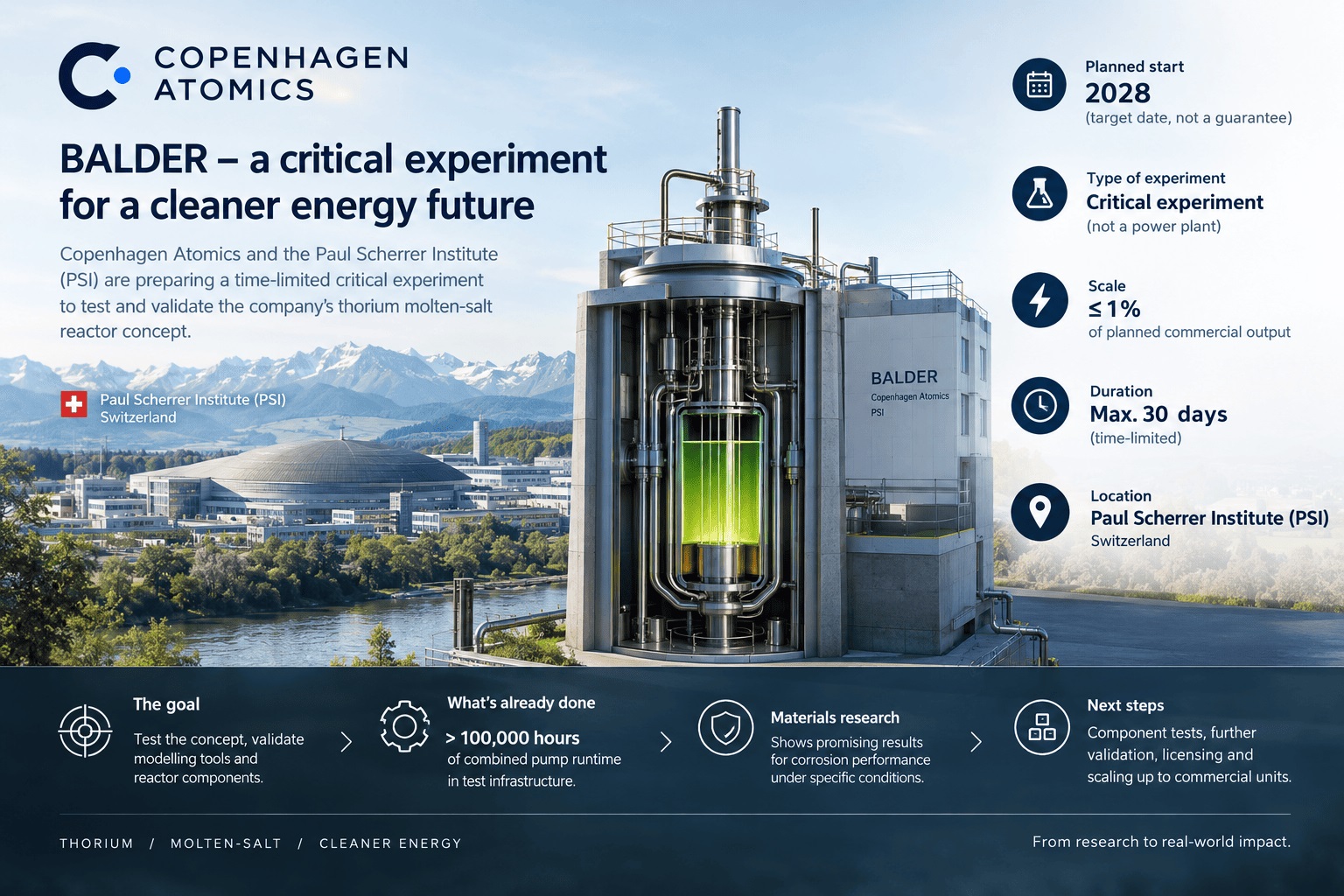
Ballerup, Hovedstaden Oct 12, 2026 (Issuewire.com) - The Danish developer says its BALDER experiment at Switzerland’s Paul Scherrer Institute is expected to begin in 2028. PSI describes a planned, time-limited critical experiment—not an operating power plant—and says the facility is still to be built and licensed.
Copenhagen Atomics is developing a thorium molten-salt reactor concept, but its next major public milestone is narrower and more measurable than a promise of cheap power: a planned critical experiment with the Paul Scherrer Institute (PSI) in Switzerland.
The experiment, part of the BALDER collaboration established on March 1, 2024, is intended to help test Copenhagen Atomics’ concept and validate modelling tools and reactor components. PSI says the facility required for the work is still to be built, and describes the experiment as limited to no more than one-hundredth of the planned commercial output and a maximum operating period of 30 days. PSI currently identifies 2028 as the target for the critical experiment; that is a schedule, not a completed test or guaranteed start date.
That distinction matters in a field where commercial claims depend on unresolved engineering, licensing and operating questions. Copenhagen Atomics says it has completed two full-scale, non-fission prototypes and is building a third. These prototypes are engineering test hardware; they are not evidence that the company has operated a nuclear chain reaction.
Turning test time into evidence
The company’s development case includes a substantial component-testing programme. Copenhagen Atomics reported more than 100,000 hours of combined pump runtime across its molten-salt test infrastructure, and told Nuclear Engineering International that one pump had run continuously for two years at temperatures above 600°C. Those figures describe component and test-loop operation—not reactor operating hours.
Materials performance is another central question. A study involving Copenhagen Atomics and the University of Liverpool, published in the Journal of Nuclear Materials as described by Nuclear Engineering International, tested 316L stainless steel in molten salts at temperatures up to 700°C. The report says salts containing moisture and oxides caused severe corrosion within 1,000 hours, while purified salts showed negligible corrosion after 3,000 hours. Those findings concern specific test conditions; they do not establish the lifetime performance of a commercial reactor.
The cost claim is a target
Copenhagen Atomics’ September 28, 2026 article sets a target of $30–$40 per megawatt-hour for electricity. The company’s own breakdown assigns $10/MWh to reactor and fuel costs and estimates another $20–$30/MWh for plant-owner costs, including site, turbines, civil infrastructure, grid connection, licensing and capital. The company explicitly describes the total as a target, not a measured commercial result.
Its current published commercial-unit terms list a $50 million upfront price per 100 MW-thermal reactor, plus a $2 million annual fee per unit, with prices stated in 2025 U.S. dollars and subject to inflation adjustment. That figure is not a complete plant price: the company says the owner remains responsible for items including buildings, licensing, turbines, plant operations, waste handling and decommissioning.
Copenhagen Atomics’ proposal rests on factory production of standardized modules, with the company describing a 100 MW-thermal unit and a longer-term mass-manufacturing ambition. Those are design and business goals. Commercial deployment depends on further testing, manufacturing scale-up and regulatory approvals; PSI’s BALDER project itself requires a new nuclear test facility and licensing.
What BALDER is—and is not
PSI describes the planned experiment as using low-enriched uranium fluoride molten fuel salt and heavy water moderation to generate heat through fission. Its stated purpose includes research into the technology, validation of modelling tools and demonstration of structures, systems and components. PSI also says the experiment will be delivered by Copenhagen Atomics, tested at PSI, and then leave Switzerland-
The project is therefore a step toward generating technical data—not a demonstration that a commercial thorium reactor is already operating, that the stated electricity-cost target has been achieved, or that commercial licensing is assured. Copenhagen Atomics’ own latest published schedule identifies initial BALDER testing in 2028, while its commercial cost claims remain targets.psi+1
About Copenhagen Atomics
Copenhagen Atomics is a Danish company developing thorium molten-salt reactor technology. The company says it was founded in 2014 and is based in Kastrup, Denmark.
Press contact
Copenhagen Atomics
press@copenhagenatomics.com
https://copenhagenatomics.com/
Media Contact
D4Design Studios *****@d4designstudios.com https://copenhagenatomics.com/