
Shenzhen, Guangdong Jun 25, 2026 (Issuewire.com) - Security cameras, smoke detectors, and outdoor sensors share a stubborn operational reality — they have to respond instantly at 3 AM in a January blizzard or at 2 PM under July sun, and nobody wants to hear excuses about temperature. The CR123A lithium manganese dioxide cell ended up dominating these applications because it packs 3 volts of nominal output into a compact cylindrical can, and for most installations that combination is hard to beat. The catch is that not every CR123A cell behaves the same when temperatures move toward either extreme. What separates one cell from another comes down to manufacturing decisions most buyers never see — the electrolyte recipe, how the lithium strip was prepared, whether the seal will actually hold over thousands of thermal cycles, and what safety mechanisms got built in. Understanding how High Quality CR123A Security Camera Lithium Battery Factories engineer temperature resilience means working through five thermal scenarios that security devices actually run into in the field.
At Minus 30 Degrees Celsius, How Does the Electrolyte Decide Whether a Camera Captures the Intruder or Goes Dark?
Picture an outdoor infrared camera mounted on a warehouse fence in northern Canada, January, three in the morning. A motion sensor trips and the camera needs current immediately to power the imaging circuit. If the battery can't deliver in that instant, the frame is gone and so is the evidence.
The bottleneck at extreme cold sits inside the electrolyte. As temperature drops, conventional electrolyte solutions thicken. Ion mobility falls off a cliff, internal resistance climbs, and the cell can't push enough current through the load to keep the device alive. Standard formulations designed for room-temperature consumer products often lose more than half their effective capacity by the time temperatures hit minus 20.
Manufacturers that take the cold problem seriously engineer the solvent system deliberately. Picking low-viscosity organic solvents with depressed freezing points keeps ion transport viable when ambient temperature collapses. Tuning the electrolyte salt concentration keeps conductivity within usable bounds across the full cold range. Shenzhen Pkcell Battery Co., Ltd. applies these formulation principles across its CR123A line, which is why the product holds discharge performance for deep-winter security installations, cold-chain logistics monitors, and polar research equipment that simply can't tolerate a dead cell.
At Zero Degrees Celsius With High Pulse Demand, Why Does Lithium Strip Quality Determine Flash Output?
Move slightly warmer to zero and a different problem shows up. Winter cameras with infrared flash illumination need a sharp current spike every time the shutter triggers. The battery has to jump from microampere standby to high-current burst inside a few milliseconds. If the lithium anode can't make that transition cleanly, voltage sags below the camera's operating threshold and the flash either fires weakly or doesn't fire at all.
What governs that behavior is the activation quality of the lithium strip itself. An anode with coarse grain boundaries, uneven surface oxide, or insufficient active surface area polarizes hard under sudden load. The visible result is a voltage drop big enough to ruin image quality or trigger a system reset right when the camera is supposed to be working.
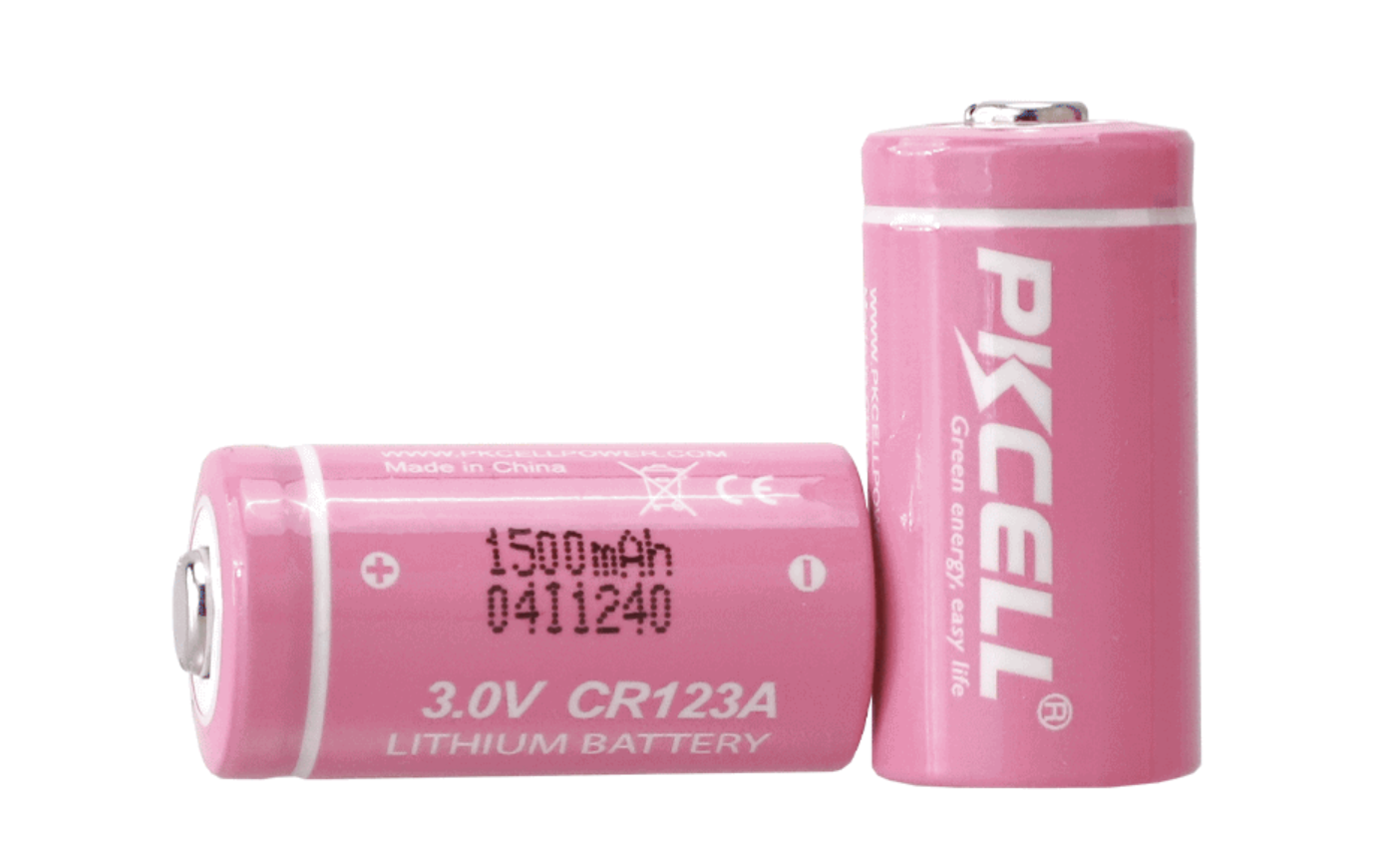
Good manufacturing handles this through controlled lithium strip processing. Surface treatment removes passive oxide layers right before assembly. Grain refinement during rolling maximizes the electrochemically active area available for fast discharge. PKCell (Shenzhen Pkcell Battery Co., Ltd.) uses these high-activity lithium strip processes across its CR123A cells, which is what supports the 1,500 mAh rated capacity with the kind of pulse output that infrared flash modules and night-vision imaging actually need when temperatures drop.
At Room Temperature, What Does Cell-to-Cell Consistency Reveal About Factory Discipline?
At 25 degrees the focus shifts from chemistry to manufacturing discipline. Security integrators assembling camera arrays — twenty units across a small site, several hundred across a campus — depend on uniform battery performance to keep maintenance schedules manageable. When voltage spread across a batch exceeds reasonable limits, some cameras start flagging low-battery warnings months ahead of others. The result is staggered replacement cycles, extra truck rolls, and service labor costs that nobody budgeted for.
Cell-to-cell consistency reflects every upstream process decision added together. Electrolyte fill accuracy controls internal chemistry uniformity. Automated assembly eliminates the human variation in crimp pressure and tab alignment that used to wreck batch performance. Post-assembly formation and sorting by voltage and internal resistance pulls cells into tight performance bands before shipment.
For security OEMs buying CR123A cells in volume, asking for batch voltage dispersion data and internal resistance distribution charts during incoming inspection reveals more about a supplier's actual manufacturing maturity than any sales pitch will. PKCell runs multi-stage sorting protocols across its CR123A lines, which narrows the performance window that OEM customers see at mass assembly and reduces the field inconsistencies that haunt large camera deployments.
At 60 Degrees Celsius Under Direct Sunlight, How Does the PTC Protection Mechanism Prevent Catastrophic Failure?
Outdoor installations in tropical regions, rooftop GPS trackers, and vehicle-cabin cameras spend summer baking under conditions that push internal cell temperatures past 55 degrees Celsius. At those levels, internal pressure rises, self-discharge accelerates, and the cell starts edging closer to the boundary of thermal stability than anyone wants.
The PTC — Positive Temperature Coefficient — element built into a properly engineered CR123A cell works as an automatic thermal fuse. When internal temperature crosses a defined threshold, the PTC's electrical resistance jumps sharply and chokes off current flow before conditions can escalate toward venting or runaway. Once the cell cools down, the PTC resets and normal operation resumes.
What makes the mechanism especially useful is that it works without any external electronics, which matters in compact devices that don't carry sophisticated battery management circuits. CR123A cells from Shenzhen Pkcell Battery Co., Ltd. carry PTC protection as a standard design element, giving passive safety coverage to fire detection systems, outdoor surveillance gear, and vehicle-mounted sensors that spend long stretches under intense solar heating.
Under Rapid Thermal Shock, What Manufacturing Process Maintains Long-Term Sealing Integrity?
The last scenario isn't about a steady temperature but a violent transition. Fire alarm smoke detectors cycle between room temperature during standby and extreme heat during actual fire events. Outdoor sensors in continental climates run through daily swings from sub-zero dawn temperatures to midday surface heat past 50 degrees. Every cycle puts mechanical stress on the seal that separates the cell's internals from the outside world.
Conventional sealing materials fatigue under repeated expansion and contraction. Micro-cracks develop in gasket compounds, opening up slow electrolyte vapor pathways that erode capacity in ways that don't surface for months. By the time the system flags a low-battery alert, the actual capacity loss has often been accumulating for years.
Whether a cell survives thousands of thermal cycles or starts leaking after a few hundred comes down to factory-level sealing discipline. The variables that matter include electrolyte injection cleanliness, crimp seal pressure consistency, and post-seal helium leak testing to verify hermeticity before cells ever leave the production floor. PKCell subjects its CR123A cells to certification testing under IEC 60086-4, UL, and UN 38.3 standards, all of which include thermal shock and abuse scenarios that put the seal through conditions more severe than typical field exposure.
The Temperature Cross-Section Acceptance Test Checklist — A Practical IQC Tool for Security OEMs
The five scenarios above translate directly into an incoming quality control checklist that security camera OEMs can apply during supplier evaluation. Five test categories deserve specific attention: loaded voltage retention at minus 30 over a defined duration, pulse current voltage sag at zero degrees simulating flash discharge, batch voltage and resistance dispersion at room temperature across a statistically significant sample, capacity retention after 60-degree storage over 30 days, and seal integrity verification following thermal shock cycling between minus 20 and plus 70 degrees.
Running this checklist across multiple CR123A suppliers surfaces performance differences that room-temperature datasheets alone will never reveal. Cells that look identical at 25 degrees can diverge sharply once temperature extremes enter the test bench, and that divergence is exactly the gap between commodity manufacturing and temperature-engineered production.
Shenzhen Pkcell Battery Co., Ltd. offers a practical reference baseline for the exercise, combining optimized electrolyte formulation, high-activity lithium strip processing, batch consistency controls, integrated PTC safety, and certification-verified sealing integrity inside a single CR123A product platform. Additional specifications, certification documentation, and OEM customization details are available at https://www.pkcellpower.com/.
Media Contact
Shenzhen Pkcell Battery Co., Ltd. *****@pkcellpower.com 902, Tower B, Hongrongyuan North Station Center, North Station Community, Minzhi Street, Longhua District, Shenzhen, China https://www.pkcellpower.com/