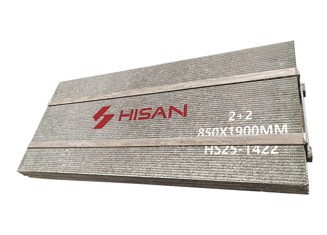
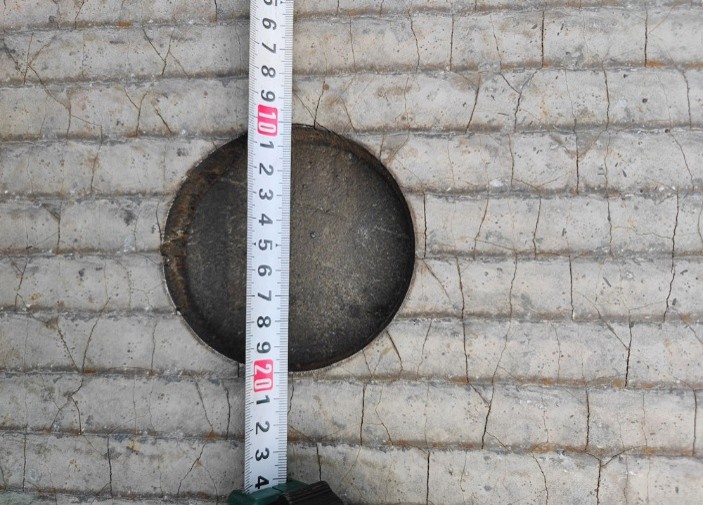
Tianjin, China Jul 26, 2026 (Issuewire.com) - How long does chromium carbide overlay plate last? The service life of a Chromium Carbide Overlay Plate is seldom a single number. Across mining, cement, power generation, port, and steel operations, how long a wear plate lasts depends on abrasion intensity, impact level, material flow, plate thickness, product grade, and the way each part is fabricated and installed. HISAN (TIANJIN) CO.,LTD, a professional CCO plate factory, defines a chromium carbide overlay plate as a bimetallic material that fuses a wear-resistant alloy layer to a mild steel base plate. That structure turns lifespan from a rough field estimate into a set of readable parameters, including a macro-hardness of 57 to 63 HRC and abrasion performance measured to ASTM G65 Procedure A.
Service Life Depends on Operating Conditions
From an engineering perspective, in high-abrasion service, the life of an overlay wear plate depends first on the material being handled, its speed, drop height, impact, and any tendency to stick. The same plate behaves differently in coal-fired power, cement, mining, port, and steel mill environments, because each imposes its own wear mechanism. Mining truck bed liners and chutes face impact and sliding abrasion at once, cement vertical roller mills and feed chutes grind fine and aggressive material, and steel mill hoppers and distribution chutes combine heat with heavy flow. HISAN builds its CCO plate range around this reality, spanning severe abrasion, low-to-moderate impact, medium-to-high impact, and extremely severe abrasion. Judging service life then becomes a matter of matching grade to condition rather than reading a single hardness figure, since a plate that thrives in one component can wear quickly in another.
Overlay Thickness and Base Plate Design Shape Wear Reserve
Overlay thickness is the physical reserve behind a long service life. HISAN grades such as HS100, HS200, HS300, and HS600 offer overlay thickness from 2-80 mm over base material from 2-150 mm, with combinations that step up from light duty to heavy-load work. The mild steel backing carries structural integrity and gives room for welding, bolting, and forming, while the wear-resistant overlay takes the abrasion. Thicker is not automatically better; the right build matches wear rate, impact, part weight, installation space, and maintenance cycle.
Product Grade Selection Determines How the Plate Handles Abrasion and Impact
Grade choice is where a chromium carbide overlay plate lifespan is largely decided. HS100 suits severe abrasion with low-to-moderate impact, while HS200 carries a higher chromium content and an ASTM G65 result of 0.18 g or less for tougher abrasive duty. HS300 uses a complex carbide system, combining chromium, niobium, molybdenum, vanadium, and titanium carbides to handle high abrasion together with medium-to-high impact. For the harshest zones, HS600 targets extremely severe abrasion at 60 to 65 HRC. In a lifespan discussion, grade selection represents a technical decision made after the working condition is understood, not as a brand slogan.
Surface Condition and Material Flow Can Shorten or Extend Real Service Life
Real service life also depends on surface condition and how freely material moves. Where handling involves sticky material, hang-ups, or concentrated scouring, an ordinary wear estimate shifts with blockages and cleaning frequency. HISAN answers this with HS-F Smooth Surface Chromium Carbide Overlay Wear Plates, which use a smooth face, no welding beads, a uniform fusion line, and 58 to 65 HRC to reduce hang-ups in coal preparation, feed and discharge systems, storage bins, and power plant chutes. In practice, hardness alone does not decide life when material flow is the real constraint.
Fabrication Quality Turns Plate Performance into Installed Lifespan
Installed service life is determined by whether a plate can be cut, formed, welded, bolted, assembled, and ground to the true shape of a component. Fabrication that damages the overlay, or an installation that fights the base plate support, keeps laboratory numbers from reaching the field. HISAN fabricates its plates through cutting, forming, welding, stud attachment, assembling, and grinding, supported by plasma cutting, bending, flattening, and multi-torch welding equipment. Cut-to-size wear parts and formed liners let a plate follow the contour of a chute, hopper, or pipe rather than force the equipment to accept a flat panel. That capability closes the gap between a plate specification and a finished, installed part, which is where much of the promised wear reserve is either kept or lost.
Testing and Inspection Make Lifespan Claims More Defensible
Credible lifespan language rests on measurable parameters rather than open promises. HISAN publishes hardness, composition, ASTM G65 Procedure A results, surface finish, and metallographic structure for its grades, and inspects them with Vickers and portable hardness testers, spectrometers, thickness testers, an ASTM G65 wear test machine, and a metallographic microscope. Taken together, these give lifespan a defined boundary: hardness explains the wear base, thickness explains the reserve, composition and microstructure explain the alloy system, and ASTM G65 gives a comparable measure of abrasive-wear performance.
HISAN Frames Lifespan as a Sourcing Decision Across Plate, Application, and Factory Support
For procurement, maintenance, and spare-parts planning, the useful answer is not a fixed lifespan but a combined view of operating condition, grade, thickness, fabrication, and inspection evidence. As a professional CCO plate factory, HISAN pairs its chromium carbide overlay plate range with welding wire, overlay wear pipe, wear parts, and overlay welding and repair service, backed by production equipment, testing capability, and application coverage across mining, cement, power, port, steel, and bulk material handling. The technical conclusion is clear: a longer service life comes from reading the working condition first, then choosing the grade, thickness, surface, and fabrication that fit it, and confirming the result with test data rather than a promised number.
About HISAN
HISAN (TIANJIN) CO.,LTD is a wear-resistant material manufacturer that supplies chromium carbide overlay plate, welding wire, overlay wear pipe, and wear parts to industrial operations worldwide. Working from a 16,000-square-metre facility with an annual production capacity of about 26,000 tons, the company helps customers reduce maintenance frequency, extend equipment availability, and control long-term operating cost through wear-resistant material, factory fabrication, testing equipment, and application support.
Operators evaluating CCO plate grade, thickness, and fabrication for mining, cement, power plant, port, steel mill, or bulk material handling conditions can share their working conditions with the HISAN team through the official website at https://www.hisancco.com/
Media Contact
HISAN (TIANJIN) CO.,LTD. *****@hisantech.com +86 22 84776558 NO.3, Xingang Wuhao Road, Jinnan District, Tianjin, China https://www.hisancco.com