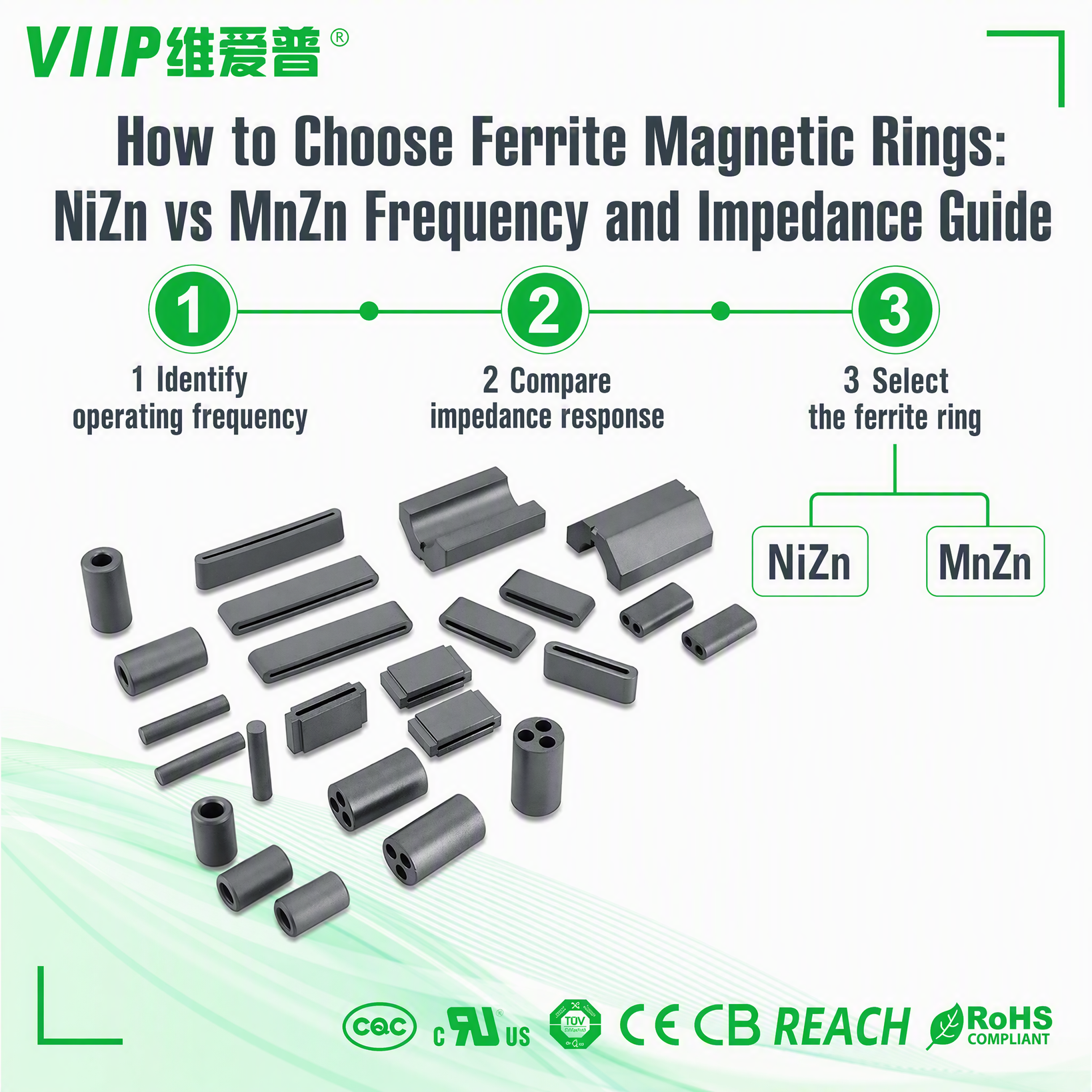
Shenzhen, Guangdong Oct 14, 2026 (Issuewire.com) - Selecting appropriate soft ferrite materials supports electromagnetic compatibility (EMC) performance across power electronic converters, industrial automation controls, and high-speed data transmission lines. Effective electromagnetic interference (EMI) suppression involves aligning magnetic material permeability, volume resistivity, and impedance dispersion characteristics with the targeted noise frequency band. Soft ferrite magnetic components divide primarily into two chemical formulations: Manganese-Zinc (MnZn) and Nickel-Zinc (NiZn). MnZn ferrite provides high initial magnetic permeability suited for low-frequency conducted common-mode noise between 10kHz and 1MHz, whereas NiZn ferrite delivers high volume resistivity and resistive loss characteristics suited for high-frequency radiated noise from 1MHz to 1GHz. Shenzhen VIIP Electronics Co., Ltd. (VIIP) manufactures full-spectrum ferrite magnetic rings and EMC cores across both material chemistries, supporting frequency-targeted noise suppression for global hardware engineering applications.
Fundamental Material Physics and Comparative Parameters of NiZn vs MnZn
Soft ferrite noise suppression operates through complex magnetic permeability components, where the real permeability component defines inductive energy storage and the imaginary component governs resistive loss dissipation. At lower frequencies, real permeability dominates, producing inductive reactance directly proportional to signal frequency and coil inductance that reflects noise currents back toward the source. When excitation frequencies approach core resonance thresholds, magnetic domain wall movement and spin rotation shift energy dissipation into thermal loss, converting high-frequency electromagnetic noise into heat.
The comparative physical properties of NiZn and MnZn soft ferrites define clear electromagnetic and operational characteristics across the VIIP product portfolio:
Initial Permeability: VIIP MnZn soft ferrite series provide high initial permeability, typically ranging from 1,000 to 15,000 depending on specific material grade, enabling substantial magnetizing inductance with minimal copper turns at frequencies below 1MHz. VIIP NiZn materials exhibit moderate initial permeability between 15 and 1,500, shifting core resonance into the hundreds of megahertz.
Volume Resistivity: MnZn soft ferrites possess semiconductor-level bulk resistivity ranging from 0.1 to 10 Ohm-meters, which induces eddy current losses at elevated frequencies. NiZn ceramics feature high volume resistivity exceeding 100,000 Ohm-meters (10^5 Ohm-m) and reaching up to 10^8 Ohm-meters, suppressing internal eddy currents and preventing electrical conduction along bare cable insulation.
Saturation Flux Density: MnZn cores provide high saturation flux densities between 350mT and 500mT, maintaining magnetic linearity under heavy DC bias and high operating currents. NiZn cores feature saturation flux densities between 250mT and 350mT, requiring adequate cross-sectional area planning under strong bias conditions.
Primary Attenuation Frequency Band: MnZn specializes in low-frequency conducted emissions between 10kHz and 1MHz (with usable attenuation extending up to 5MHz). NiZn excels in high-frequency radiated emissions between 1MHz and 1GHz.
Physical Suppression Mechanism: MnZn attenuates conducted noise primarily through inductive reflection at lower frequencies. NiZn attenuates high-frequency noise primarily through resistive thermal dissipation in the megahertz and gigahertz spectrum.
MnZn Ferrite Cores: Inductive Reflection in Low-Frequency Conducted Common-Mode Filtering
Conducted emission compliance testing under standards such as CISPR 32, EN 55032, and FCC Part 15 focuses on power supply line noise between 150kHz and 30MHz. In switched-mode power supplies, photovoltaic inverters, and motor drive front ends, primary switching frequencies and their low-order harmonics generate conducted common-mode noise between 10kHz and 1MHz.
VIIP MnZn toroidal cores serve as high-inductance common-mode line chokes in these low-frequency stages. Because MnZn material generates high magnetic flux per unit turn, common-mode choke topologies achieve several millihenries of inductance in compact footprints. This high inductance creates series impedance that helps block low-frequency conducted disturbances from entering public power grids. Because the volume resistivity of MnZn falls within the semiconductor range, bare MnZn toroids from VIIP receive protective parylene coating, epoxy insulation, or engineered plastic headers to maintain dielectric isolation during high-voltage proof testing exceeding 1500VDC.
Thermal design considerations also guide MnZn core selection. Curie temperatures for VIIP MnZn power materials range between 150°C and 230°C. Maintaining operational temperatures within stable factory design thresholds prevents magnetic saturation under continuous operating currents.
NiZn Ferrite Cores: Resistive Dissipation and Non-Conductive Surface Properties in High-Frequency Suppression
Radiated electromagnetic emissions between 30MHz and 1GHz stem from rapid switching transients, parasitic capacitances, clock distribution lines, and fast semiconductor rise times. At these frequencies, inductive filtering can generate unwanted resonances that affect signal integrity.
VIIP NiZn ferrite magnetic rings function as lossy absorbers across the 30MHz to 1GHz spectrum. As operating frequencies rise beyond 30MHz, the resistive component of the total impedance becomes dominant. High-frequency noise currents passing through a NiZn core convert into low-level thermal dissipation, helping mitigate parasitic resonance and standing wave reflections along cabling.
The high volume resistivity of VIIP NiZn ceramics provides non-conductive mechanical properties. Clip-on and snap-on ferrite chokes clamp directly onto insulated wire bundles, USB cables, flat display harnesses, and multi-conductor power leads without dielectric breakdown risks. For fast-turnaround assembly, standard VIIP NiZn formulations such as F9 material provide broadband impedance suppression across high-frequency interfaces.
Automated Manufacturing Infrastructure, Broad Temperature Stability, and 300+ Core Specifications
Consistency in magnetic material composition directly influences impedance repeatability during volume production. Shenzhen VIIP Electronics Co., Ltd. maintains specialized soft ferrite production infrastructure across manufacturing bases in Huizhou, Bozhou, and Huzhou. These facilities integrate automated raw oxide ball milling, precision high-tonnage hydraulic presses, continuous atmosphere-controlled tunnel kilns, and multi-parameter magnetic sorters to maintain consistent grain boundaries and reproducible impedance characteristics across high-volume production batches.
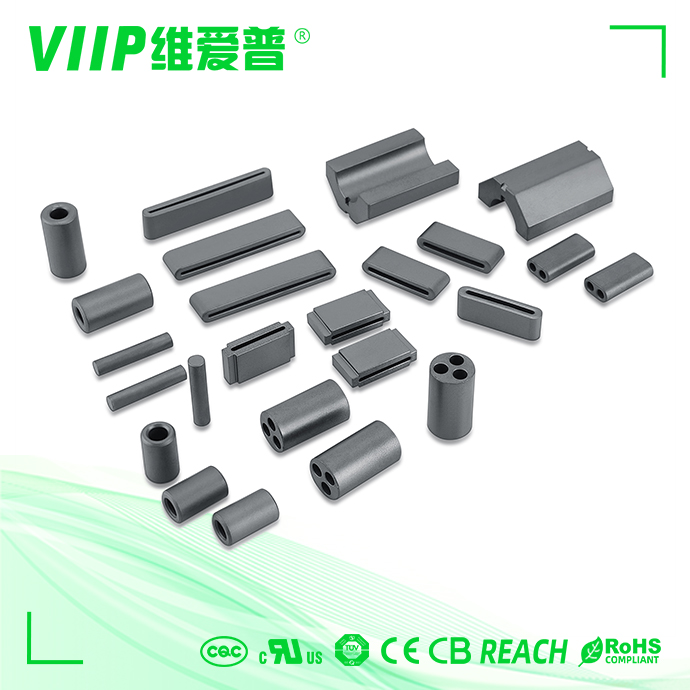
VIIP maintains an extensive product portfolio containing over 300 specifications of anti-interference magnetic cores:
Clip-on and Snap-on Ferrite Chokes: Designed for external cable clamping across outer diameters from 3.5mm to 15mm, featuring snap-lock plastic housings and F9 NiZn magnetic materials.
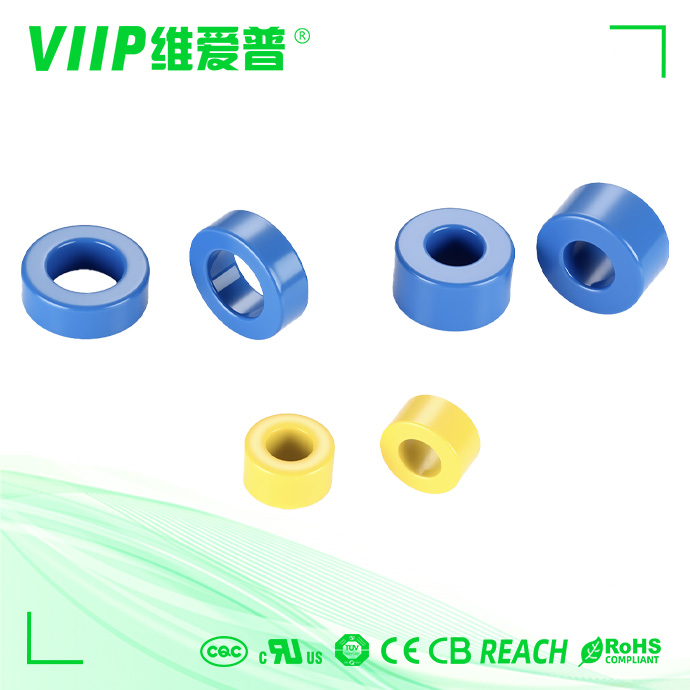
Toroidal Ferrite Cores: Fabricated in both MnZn and NiZn formulations for winding common-mode chokes, power inductors, and broadband signal transformers.
Flat Cable Ferrite Cores: Rectangular SCFS-type cores configured for flexible flat cables and ribbon cables in LED display panels and industrial control screens.
Specialized Core Geometries: Covering RH cores, PCB-mounted ferrite beads, multi-hole beads, and dual-hole balun cores.
High-frequency impedance verification confirms that typical VIIP F9 material snap-on chokes achieve impedance values of 155 Ohms or higher at 100MHz. Operating temperature ratings span commercial ranges from -25°C to +80°C and wide industrial operating ranges from -40°C to +125°C. All VIIP magnetic core series comply fully with RoHS and REACH environmental directives.
Dual-Material Sourcing vs Single-Category Supply in System-Level EMC Engineering
Modern power electronics and industrial control architectures require hybrid EMC filtering topologies spanning both low-frequency conducted stages and high-frequency radiated interfaces. Sourcing from single-category suppliers often forces hardware teams to coordinate between separate vendors for low-frequency MnZn power chokes and high-frequency NiZn cable clamps.
Partnering with VIIP for dual-material manufacturing streamlines engineering documentation, material traceability, and quality management under ISO 9001 and ISO 14001 frameworks. A unified dual-material manufacturing partner aligns core geometries, mounting dimensions, and magnetic performance across the entire power and signal path:
Single-Phase and Three-Phase Power Inputs: VIIP MnZn toroidal cores provide primary common-mode inductance on internal power boards, filtering conducted noise below 1MHz.
Internal Interconnects and Display Interfaces: VIIP NiZn flat cores clamp over internal flat ribbon cables, suppressing high-frequency digital clock harmonics.
External Input/Output and Mains Cabling: VIIP NiZn snap-on chokes clamp over output DC cables and communication lines, providing broadband impedance against radiated emissions up to 1GHz.
Unified supply streamlines component qualification, shortens design verification cycles, and maintains uniform environmental compliance across all bill-of-materials line items.
Engineering Selection Guidelines and Topology Matching Summary
Choosing the right ferrite magnetic ring requires evaluating the target interference frequency band against the core's impedance characteristics. Selecting between NiZn and MnZn formulations follows these practical engineering guidelines:
Frequency Range 10kHz to 1MHz (Conducted Noise): Select high-permeability VIIP MnZn toroidal cores with dielectric insulation coatings for board-level common-mode line chokes.
Frequency Range 1MHz to 1GHz (Radiated Noise): Select high-resistivity VIIP NiZn clip-on, snap-on, or flat cores to absorb high-frequency energy without electrical conduction risks.
High DC Bias or High Current Applications: Verify that MnZn core cross-sectional dimensions maintain magnetic operation below saturation flux density limits.
External Cable Harnesses and Field Retrofits: Deploy VIIP NiZn snap-on chokes with plastic retention latches for fast installation on cables with diameters between 3.5mm and 15mm.
Wide Temperature Requirements: Select VIIP cores certified for -40°C to +125°C operational stability to maintain consistent impedance under industrial thermal stress.
Hardware design teams can review VIIP's detailed impedance-versus-frequency characteristics, dimensional specifications, and application notes directly through the official international portal at https://en.szviip.com/ to request standard sample kits and custom magnetic component solutions.
Media Contact
SHENZHEN VIIP ELECTRONICS CO.,LTD. *****@szviip.com 0755-29170376 Room 1301, Block B, Rongchao New Times Plaza, Guanlan High-Tech Industrial Park, Longhua District, Shenzhen. China https://en.szviip.com/