Shenzhen, Guangdong Jun 25, 2026 (Issuewire.com) - The Euro-Zone Grid Modernization: LPWAN Proliferation and the Unforgiving Power Demand
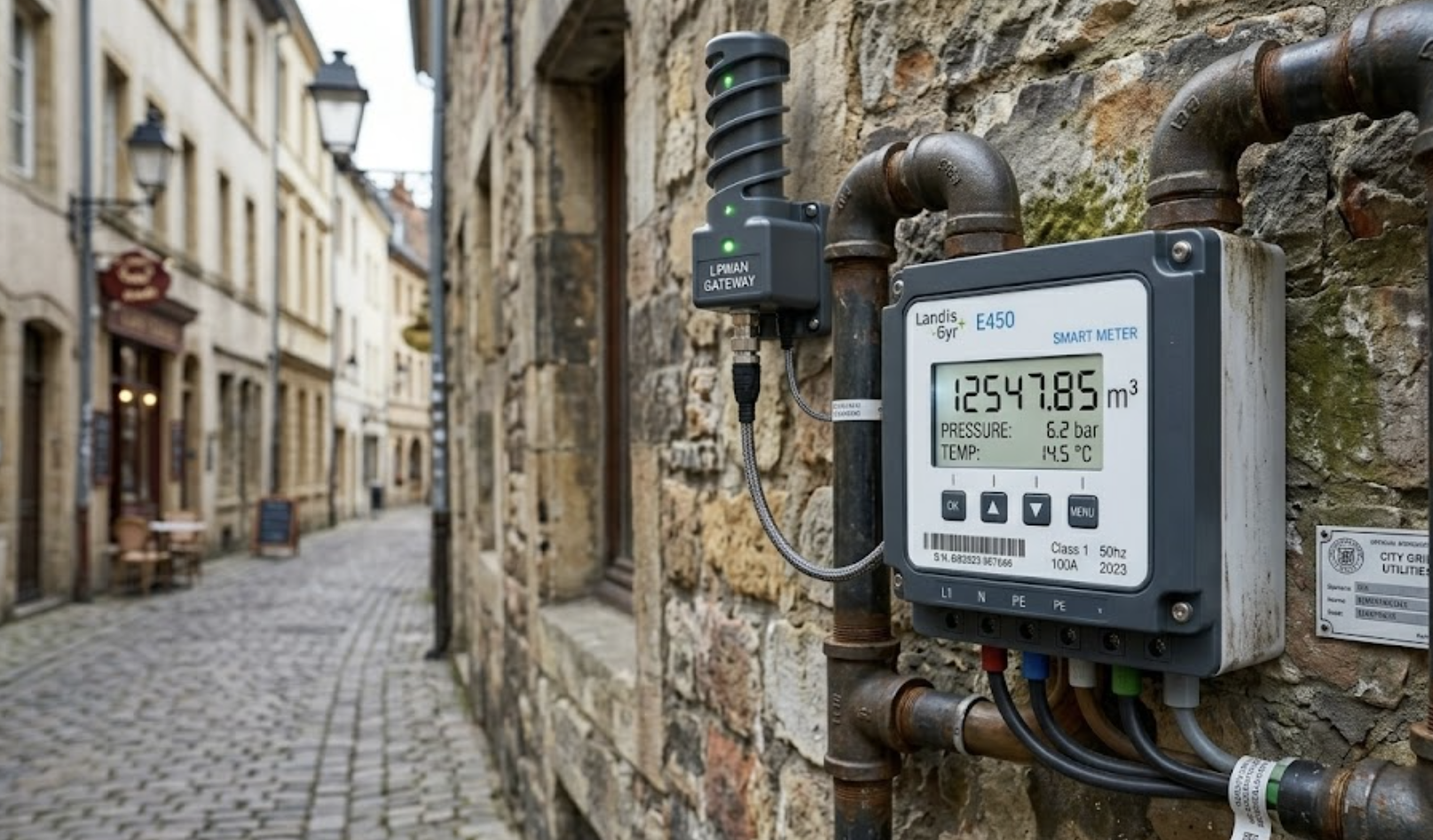
Europe's utility sector is in the middle of a genuine infrastructure overhaul. Regulatory pressure around energy efficiency has pushed providers across the continent to retire aging mechanical meters and replace them with smart gas, water, and heat metering systems that communicate continuously. The operational logic is sound — real-time consumption data cuts distribution waste, enables dynamic pricing, and removes the labor cost of manual reads. But running all of that wireless communication over fifteen-year deployment windows creates a power supply problem that isn't always obvious at the procurement stage. More European infrastructure teams are turning to a qualified China Top LiSOCl2 HPC Hybrid Pulse Battery Pack Supplier to source components that can actually meet those timelines without field intervention.
The shift to LoRaWAN and NB-IoT protocols sits at the center of this challenge. Older automated metering systems worked with short-range radio over relatively modest distances. Modern IoT-enabled meters push data through dense urban building stock or from underground vault installations — conditions that demand considerably more from the RF transceiver. The energy draw isn't constant; it's intermittent and intense. A meter might sit in microampere sleep mode for hours, then briefly pull several amperes during a synchronization cycle. That electrical pattern is fundamentally different from what earlier battery designs were built around.
Network conditions add another variable. When a meter struggles to reach a distant cell tower — a common scenario in basement installations or thick-walled buildings — the transceiver runs at maximum power draw for an extended period. If the battery can't sustain that without a voltage collapse, the transmission simply fails. For utility companies operating on thin margins, a failed transmission isn't just a technical inconvenience. It represents a data gap, a potential billing error, and eventually a truck roll. Asset managers in the European utility sector have settled on fifteen years as the benchmark for total cost of ownership calculations, and battery selection is increasingly where those numbers are won or lost.
Decoupling the Passivation Trap: Why Standard Lithium Batteries Falter in European Winters
Lithium Thionyl Chloride has dominated industrial metering applications for good reasons — high energy density, flat discharge curve, long shelf life. But there's a physical characteristic of the Li-SOCl2 system that creates real problems in pulse-driven applications, and it becomes significantly worse in cold climates.
When a Li-SOCl2 cell sits idle for an extended period, a thin film of lithium chloride crystals forms on the surface of the lithium anode. This passivation layer is actually useful in one respect: it acts as an internal insulator, slowing ion migration and reducing self-discharge to nearly negligible levels. That's part of why these cells can hold their charge for a decade. The problem surfaces when the device suddenly demands power. The passivation layer resists immediate current flow, causing a temporary voltage dip before the chemical film breaks down. In applications with gentle, predictable loads, this isn't particularly damaging. In LPWAN-enabled smart meters that wake up abruptly and demand high pulse currents, it can mean a failed transmission or a controller reset.
European winters push this vulnerability further. In Central, Eastern, and Northern Europe, temperatures regularly drop well below freezing — occasionally reaching -20°C. Cold slows electrochemical kinetics and thickens the electrolyte, compounding the resistance that passivation already creates. The result, in the worst cases, is a voltage transient that falls below the meter's minimum operating threshold. The micro-controller resets, the data packet is lost, and the meter drops offline. Do that repeatedly, and you're not just losing data — you're accelerating cell degradation and pulling forward the timeline for a replacement that was supposed to be fifteen years away.
The ER + HPC Architecture: Deconstructing the Hybrid Pulse Solution Reshaping the Market
The engineering response to this problem is a parallel hybrid architecture that separates the energy storage function from the pulse delivery function. Rather than asking a single cell to handle both tasks — steady long-term discharge and high-current bursts — the design splits them between two components: a Bobbin-type Lithium Thionyl Chloride primary cell (the ER cell) and a Hybrid Pulse Capacitor (HPC).
The ER cell's job in this arrangement is straightforward: act as a long-term energy reservoir, optimized purely for stable, low-drain output and minimal self-discharge. It continuously feeds a microscopic trickle charge to the HPC, which accumulates and holds that energy until the meter needs it. When the LPWAN transceiver fires, the HPC delivers the high-current pulse directly — the primary cell never sees that electrical stress. This isolation is what solves the passivation problem. Because the ER cell isn't being subjected to pulse demands, the passivation layer stays thin and manageable. There's no voltage delay, no winter performance cliff, and no accumulated damage to the core chemistry from repeated pulse events.
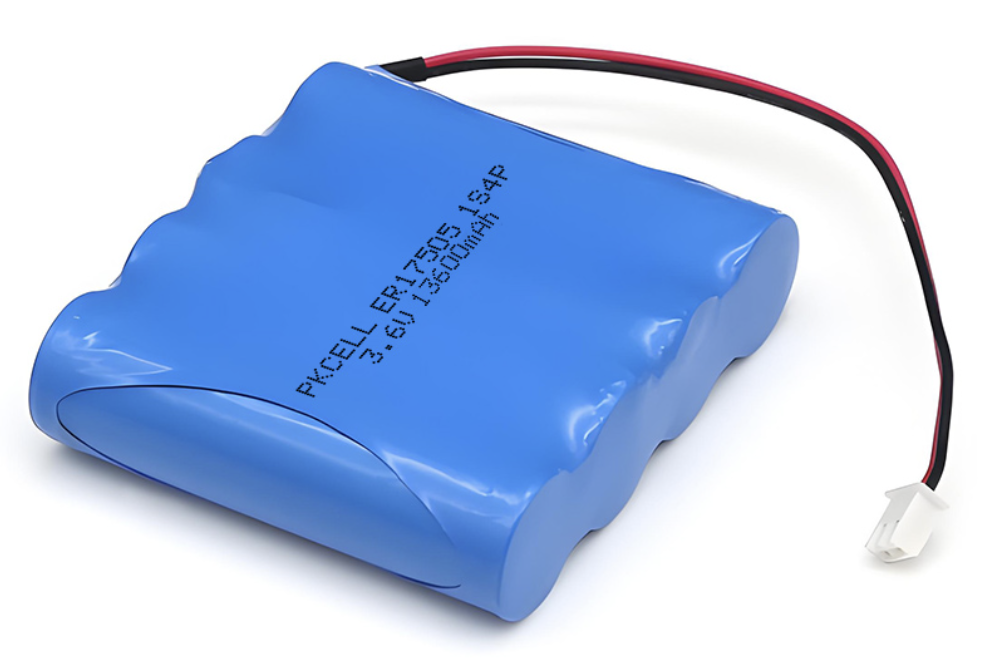
The practical outcome is a system that maintains stable 3.6V nominal output alongside robust current delivery under almost any load scenario. For compact meter housings where space is tight, engineers often turn to purpose-built formats such as the 3.6V ER17505 1S4P battery pack, which fits narrow enclosures without sacrificing pulse capability. The HPC's inherently low internal resistance also means cold-weather performance holds up well — ion movement in the capacitor isn't slowed by temperature the way it is in a conventional lithium primary cell. For a utility meter installed in a Finnish basement or a Polish outdoor cabinet, that characteristic matters considerably over a fifteen-year service life.
Strategic Advantages: How PKCELL Bridged Technical Innovations with European Regulatory Barriers
Getting the electrochemistry right is one thing. Actually selling into the European utility market is another. The procurement process for municipal infrastructure components in Europe involves multiple layers of quality verification, environmental compliance, and transport safety certification that many suppliers find difficult to navigate consistently at scale.
PKCell (Shenzhen Pkcell Battery Co., Ltd.) has built its European market position around addressing both sides of that equation. On the manufacturing side, fully automated production lines handle the assembly steps most sensitive to variation — electrode winding and electrolyte injection — which keeps internal resistance and capacity profiles consistent across batches. For utility-scale deployments where a single underperforming batch can create network gaps across thousands of endpoints, that level of process control isn't a minor detail. Finished hybrid packs go through extended thermal cycling in dedicated test chambers, verifying structural and chemical integrity across the full range of operating temperatures that European field conditions actually produce.
The compliance side of the equation gets equal attention. PKCell's industrial battery solutions meet the EU's RoHS directive and REACH regulation, confirming the absence of banned heavy metals and hazardous substances — a requirement that also simplifies end-of-life recycling obligations for European municipal operators. CE marking and UN38.3 transport certification cover the logistics side, allowing shipments to move across borders without the customs complications that non-certified goods routinely encounter.
What the leading Chinese suppliers have figured out is that European utility procurement teams aren't just buying a battery — they're buying a component that has to perform reliably for fifteen years in difficult conditions, meet a stack of regulatory requirements, and not create a supply chain problem mid-contract. Suppliers who treat those requirements as a genuine engineering commitment rather than a paperwork exercise have found real traction in a market that's growing faster than most expected.
Corporate Website: https://www.pkcellpower.com/.
Media Contact
Shenzhen Pkcell Battery Co., Ltd. *****@pkcellpower.com 902, Tower B, Hongrongyuan North Station Center, North Station Community, Minzhi Street, Longhua District, Shenzhen, China https://www.pkcellpower.com/