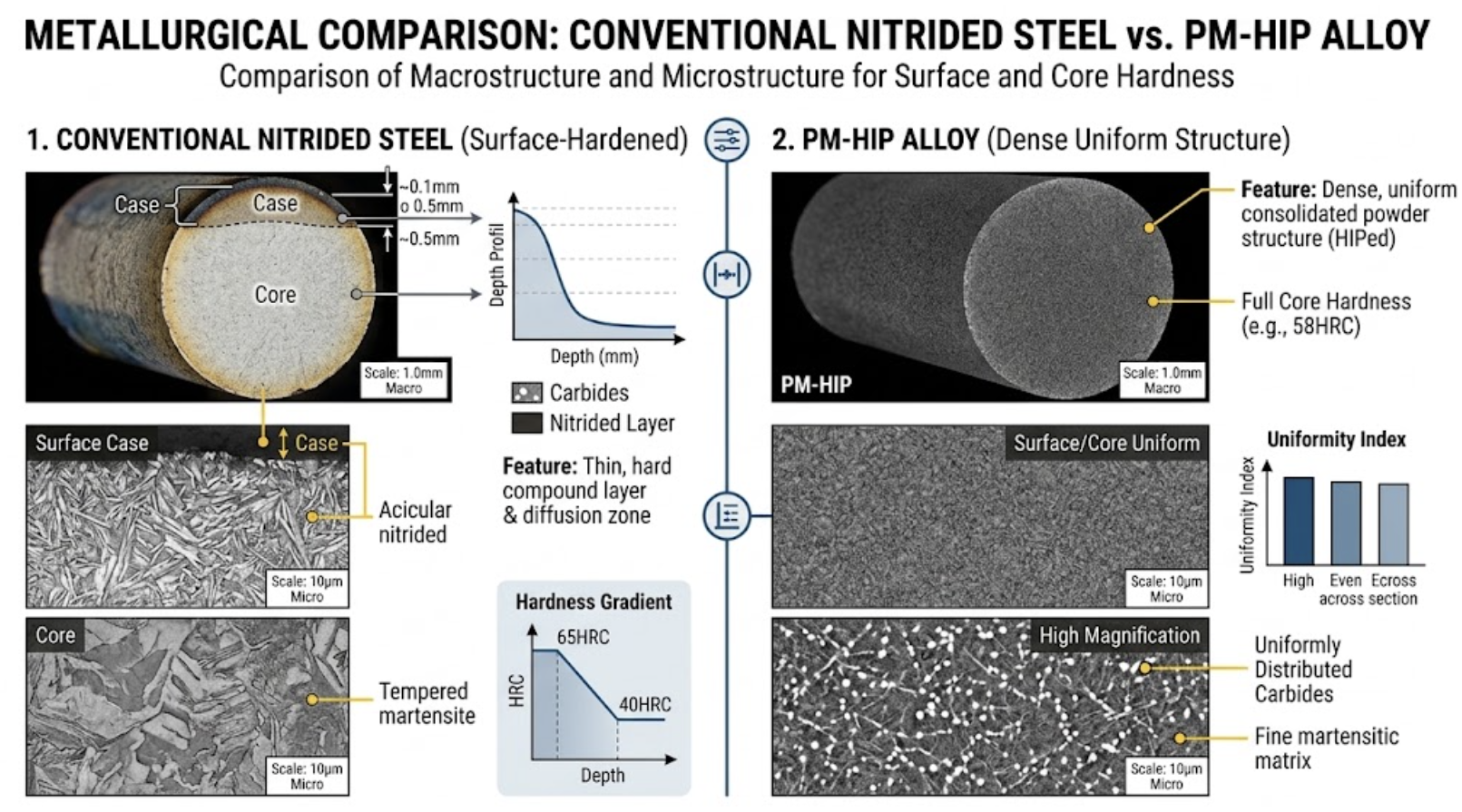
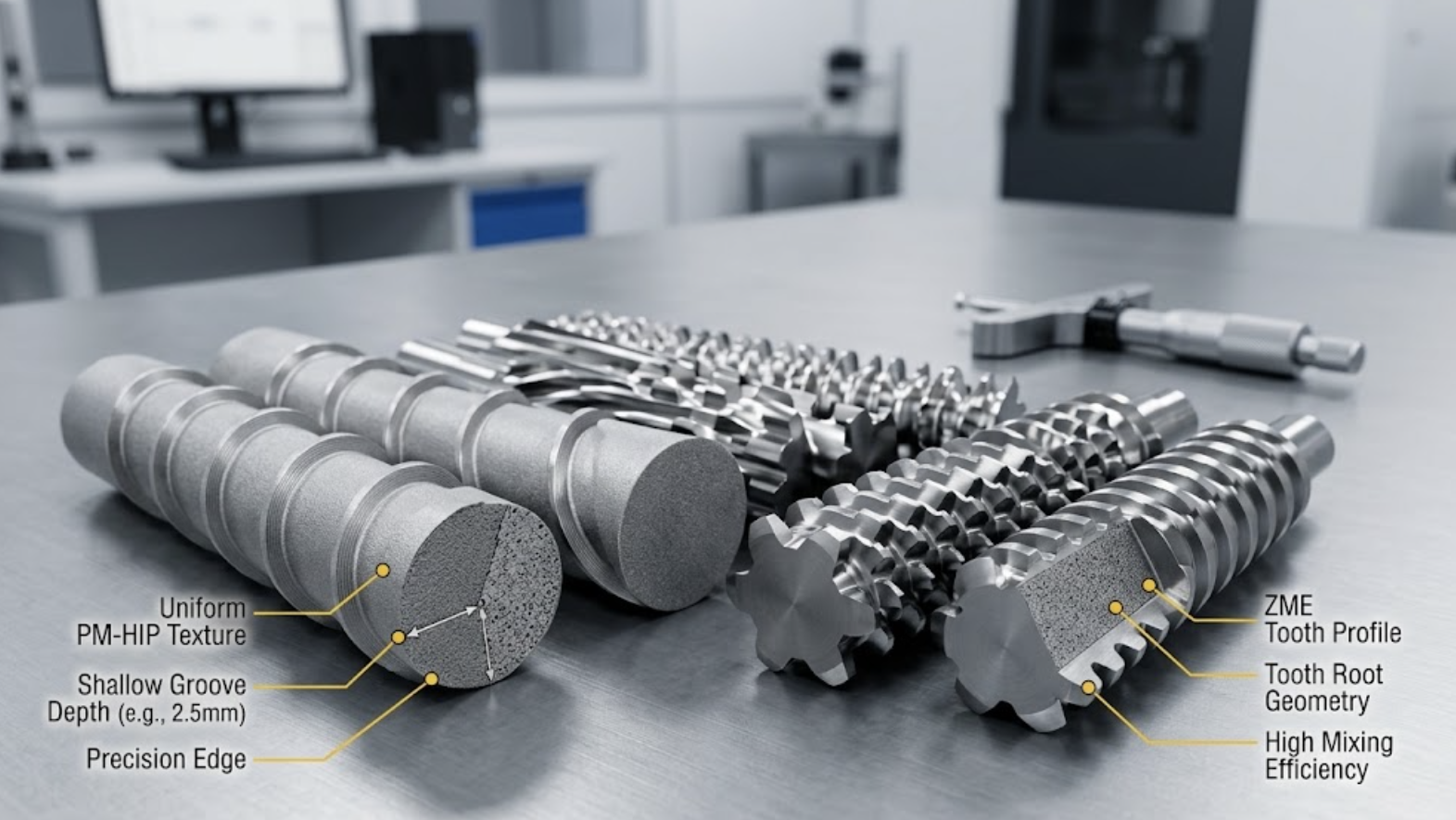
Nanjing, Jiangsu Nov 12, 2026 (Issuewire.com) - Nitrided Steel, Conventional Tool Steel, and PM-HIP Alloy for Twin-Screw Elements: Material Selection for Filled and Modified Plastic Compounding Introduction: Material Selection Challenges for Twin-Screw Elements Under High-Filler and Aggressive Compounding Polymer compounding plants face escalating demands for high-performance engineering plastics across global markets. Today, processors routinely incorporate heavy filler loadings, such as 30% to 50% glass fiber, mineral powders, and halogenated flame retardants. While these additives enhance mechanical strength and thermal resistance, they introduce severe abrasive and corrosive stresses inside extrusion barrels. Plant managers frequently ask whether traditional nitrided steels, conventional quenched-and-tempered tool steels, or advanced powder metallurgy alloys offer true economic advantages. Inside every co-rotating twin-screw extruder, the durability of each twin-screw element determines whether a compounding line operates continuously or suffers unexpected downtime. Selecting between surface-nitrided steels, conventional tool steels, and powder metallurgy hot isostatic pressing (PM-HIP) alloys requires analyzing specific formulation characteristics. Furthermore, choosing the wrong material leads either to premature mechanical failure or to unnecessary capital expenditure. A balanced technical analysis reveals that no single material is universally superior; rather, operating parameters, filler volume, and polymer chemistry dictate the correct metallurgical match. Microstructural Analysis: Performance Boundaries of Nitrided Surfaces, Conventional Tool Steels, and PM-HIP Bulk Homogeneity Understanding the metallurgical differences between surface-treated nitrided steels, conventional tool steels, and PM-HIP alloys explains their distinct performance limits under severe extrusion conditions. Nitrided steel (such as 38CrMoAl) relies on a thermo-chemical surface treatment that diffuses nitrogen into the alloy matrix, producing a thin, ultra-hard surface layer reaching 65 to 70 HRC, while the core remains relatively soft and tough. Meanwhile, conventional quenched-and-tempered tool steels (such as high-carbon high-chromium Cr12MoV or high-speed tool steels like W6Mo5Cr4V2) offer higher bulk hardness than nitrided steels through traditional ingot metallurgy, providing better baseline wear resistance. However, ingot-based conventional tool steels suffer from macro- and micro-segregation, containing coarse, unevenly distributed eutectic carbides that act as stress concentration sites, making them prone to chipping under heavy mechanical shock. In low-fill or standard polyolefin compounding, nitrided and conventional tool steels deliver cost-effective service; yet, rigid glass fibers or mineral particles gradually pit or erode their surfaces or fracture their coarse carbides. Once abrasive wear breaches the thin nitrided case or degrades conventional tool steel surfaces, degradation accelerates rapidly. In contrast, PM-HIP alloys utilize gas atomization to transform molten metal into ultra-fine spherical powders consolidated under extreme pressure and temperature in a hot isostatic press. This eliminates micro-segregation, yielding a fully isotropic, homogeneous bulk structure packed with uniform, fine vanadium or chromium carbides. Consequently, PM-HIP components maintain consistent hardness and exceptional wear resistance throughout their entire wall thickness, even after millimeter-level wear, while delivering superior fracture toughness to resist catastrophic chipping. Operational Zone Mapping: Precision Material Selection for SME, ZME, SK, and SSK Screw Elements Material selection becomes particularly critical when evaluating specific screw element geometries and their locations within the extruder configuration. Different element designs experience vast differences in localized mechanical stress, shear rates, and particle impacts. For instance, SME (https://www.lesunscrew.com/products/mixing-screw-elements/) (Shallow Groove Mixing Element) and ZME (Reverse Cut Tooth Mixing Element) geometries perform intensive distributive and dispersive mixing in high-shear plasticating zones. SME elements generate controlled melt backflow through shallow flight grooves, while ZME elements utilize cut-tooth configurations to split and recombine melt streams continuously. When processing glass-reinforced engineering thermoplastics like PA6-GF30 or PBT-GF50, glass strands and mineral fillers concentrate heavily along these narrow flight grooves and inter-tooth channels, creating extreme local abrasive pressure. If processors rely on conventional nitrided steels or brittle high-carbon tool steels for SME and ZME elements, flight edges round rapidly or suffer catastrophic edge chipping, destroying mixing efficiency. Utilizing PM-HIP alloys for these high-stress mixing geometries preserves sharp functional profiles and extends service life significantly. Conversely, SK (Special Conveying Element) and SSK (Symmetric Special Conveying) elements serve distinct roles in solids feeding and conveying zones, featuring large volume capacity and optimized flight angles. In early intake zones where fillers are un-melted and sliding friction dominates, conventional nitrided steels or standard tool steels often provide adequate and economical wear resistance, keeping initial capital outlays balanced without sacrificing operational stability. The TCO Decision Framework: Balancing Initial CAPEX and Long-Term Operational Value Evaluating screw element costs solely based on initial purchase price often leads to inaccurate financial conclusions. Compounding plant operators increasingly adopt a Total Cost of Ownership (TCO) evaluation framework to guide material procurement decisions. While conventional nitrided steels and standard tool steels require significantly lower initial capital expenditure (CAPEX), their service life drops sharply in aggressive, highly filled engineering plastic compounding environments, leading to frequent element replacements every few months. Frequent changeovers incur substantial hidden operational costs, including emergency maintenance labor, unscheduled production halts, and massive material waste from off-spec startup batches. Furthermore, progressive clearance expansion between worn elements and barrel walls reduces volumetric efficiency, induces melt temperature spikes, and accelerates polymer thermal degradation. On the other hand, PM-HIP alloy elements carry a higher upfront purchase price, but their exceptional wear and fatigue resistance extend service lifespans by three to five times in severe abrasive applications. By eliminating recurring maintenance shutdowns and sustaining stable volumetric throughput, PM-HIP components dramatically lower the cost per ton of finished compound, making them highly economical for continuous, high-volume production lines. Industry Methodology: The Lesun Processing-Condition Approach and High-Torque Shaft Matching Modern extrusion engineering emphasizes matching component metallurgy directly to operational processing conditions rather than relying on generic material grades. Processing conditions—including melt temperature, screw speed, torque distribution, and filler geometry—dictate the primary degradation mechanism. Aligning with this industry philosophy, Lesun Screw advocates an objective, application-driven selection strategy. The company details this engineering methodology in its technical whitepaper on a processing-condition-based approach (https://www.lesunscrew.com/lesun-releases-new-whitepaper-advocating-a-processing-condition-based-approach-to-twin-screw-extruder-screw-material-selection.html) to twin-screw extruder screw material selection. This publication demonstrates that optimal material selection balances abrasion resistance, corrosion protection, and structural toughness across different functional zones. Furthermore, operating high-wear PM-HIP elements under demanding conditions requires robust torque transmission. When processing dense, highly filled compounds, mechanical loads concentrate heavily on the drive shaft. Combining premium PM-HIP screw elements with cold-formed high-torque screw shafts (featured across manufacturing solutions at ensures that the entire screw assembly withstands extreme torsional loads without mechanical fatigue or shaft deformation. Professional Manufacturing and Lifecycle Support: Tailored Solutions by Nanjing Lesun Screw Achieving maximum extrusion stability requires a trusted manufacturing partner capable of delivering tailored metallurgical solutions and technical lifecycle support. Operating modern manufacturing facilities backed by decades of industry experience, Lesun Screw (Nanjing Lesun Screw Co., Ltd.) specializes in engineering high-performance twin-screw extruder spare parts, including 12,000+ precision specifications compatible with major global brands. The manufacturer maintains comprehensive raw material options, ranging from certified nitrided steels and conventional tool steels to advanced PM-HIP alloys and nickel-based superalloys. Beyond component manufacturing, Nanjing Lesun Screw Co., Ltd. (https://www.lesunscrew.com/company-profile.html)provides technical services to solve recurring wear issues for international clients, utilizing advanced CMM inspection systems and multi-axis CNC machining. By offering accurate reverse engineering, drawing optimization, and tailored material matching based on operating conditions, the company helps global compounding enterprises minimize operating risks and optimize production efficiency. Discover advanced twin-screw extruder spare parts and technical solutions at Lesun Screw Official Website (https://www.lesunscrew.com/). Watch this Nanjing Lesun Screw manufacturing overview (https://www.youtube.com/watch?v=HNXxxpXAg_c) to see how precision components are produced for global extrusion systems.
Media Contact
Lesun Screw *****@lesunscrew.com http://www.lesunscrew.com/