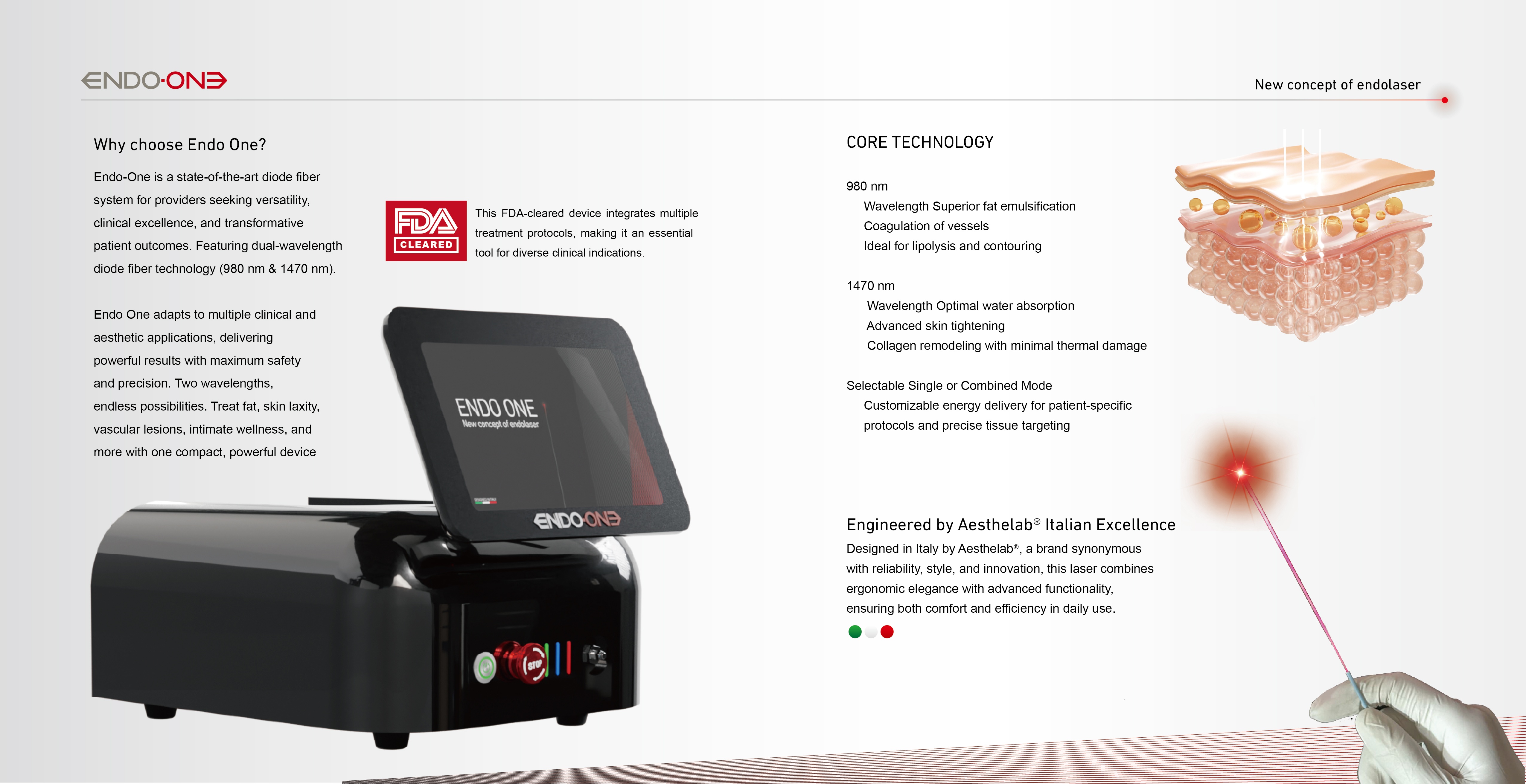
Pozzuoli, Campania Sep 22, 2026 (Issuewire.com) - Achieving a sharply defined mandibular contour requires treating both descended subcutaneous adipose tissue and overlying cutaneous laxity. Precision Jawline Definition for Aesthetic Practices demands careful anatomical assessment to separate structural bone loss and platysmal descent from soft-tissue sagging. Modern aesthetic practices must address complex lower-face aging patterns while ensuring rapid patient recovery and natural-looking outcomes.
Originating from Italian engineering team ENDO ONE SRL, the ENDO ONE system enables aesthetic clinicians to execute targeted subdermal vector treatments along the lower face. By combining localized lipolysis with fibroseptal contraction, practitioners can restore a crisp mandibular margin in an outpatient clinical setting. Operating through balanced bare-tip silica fibers, the platform delivers uniform photothermal energy along planned lower-face tension lines with high anatomical accuracy.
Differential Diagnosis of Lower-Face Aging and Contour Loss
A successful lower-face intervention begins with an accurate differential diagnosis. The visual loss of jawline sharpness stems from three interacting anatomical processes that require distinct therapeutic responses.
Clinicians must distinguish superficial dermal thinning from deep subcutaneous volume redistribution. Applying a uniform treatment to diverse anatomical presentations leads to inconsistent aesthetic outcomes and potential patient dissatisfaction.
Distinguishing Cutaneous Laxity from Subcutaneous Fat Descent
Cutaneous laxity presents as fine wrinkling, loss of skin recoil, and superficial tissue crepiness along the lower cheek and jawline. In contrast, pre-jowl fat descent appears as distinct soft-tissue fullness positioned anterior to the masseter muscle.
Treating cutaneous laxity requires photothermal stimulation within the deep reticular dermis to induce neocollagenesis. Conversely, pre-jowl fullness requires targeted energy absorption in adipose tissue to emulsify localized fat deposits before tightening the overlying skin.
Evaluating Platysmal Banding and Cervicofacial Anatomy
A blunt cervicofacial angle often involves dynamic platysmal muscle activity and subplatysmal adipose accumulation. Subdermal laser procedures address pre-platysmal fat and overlying skin laxity directly.
Practices must evaluate whether platysmal banding requires adjunctive neuromodulator therapy or surgical platysmaplasty. Patients with primary submental and pre-jowl subcutaneous laxity achieve the most dramatic definition through laser-guided fibroseptal contraction.
Procedural Planning and Vector Mapping Along the Mandibular Border
Precise vector mapping provides the operational blueprint for lower-face endolaser procedures. Clinicians map anatomical landmarks while the patient sits upright, marking the inferior border of the mandible, the pre-jowl sulcus, and submental boundaries.
Treatment vectors are designed in a fan-shaped cross-directional configuration to provide comprehensive structural support across the lower face. A primary entry point positioned immediately below the earlobe at the mandibular angle allows retrograde vector passes along the inferior mandibular rim toward the pogonion. A secondary submental midline portal located within the natural submental crease enables lateral vector passes across the submental triangle toward the hyoid bone. Operators utilize cross-hatching passes to ensure uniform thermal accumulation without surface irregularities, while maintaining precise safety margins around the facial artery notch and marginal mandibular nerve pathway.
Technical Execution: Fiber Selection and Tissue Targeting Protocol
Executing lower-face endolaser contouring requires structured procedural discipline, from fluid infiltration to final endpoint verification.
Clinicians execute lower-face contouring through a structured four-stage procedural workflow. First, the practitioner infiltrates dilute tumescent anesthesia into the subcutaneous space, providing complete local analgesia, hydro-dissecting tissue planes, and creating a protective thermal buffer. Next, a six hundred micrometer bare-tip optical fiber is introduced through a minor puncture made with an eighteen-gauge needle, advancing horizontally above the deep muscular fascia. Laser energy is then delivered in retrograde passes as the operator withdraws the fiber tip at approximately one centimeter per second. Finally, procedural endpoints are verified through continuous visual tracking of the red aiming beam and non-contact thermal sensors to ensure epidermal heat remains strictly below 40 to 42 degrees Celsius.
Managing Post-Treatment Tissue Retraction and Patient Recovery
Post-procedural management aims to control transient inflammation, support lymphatic drainage, and protect newly contracted collagen fibers.
Patients wear an elastic submental compression strap continuously for the first seventy-two hours following the procedure. Continued nocturnal compression for two additional weeks promotes uniform tissue adherence along the freshly contoured mandibular rim.
Clinical recovery follows a predictable timeline in outpatient settings. During the initial three days, mild localized swelling and minor tenderness peak before resolving rapidly. Over the subsequent two weeks, any residual bruising fades completely, revealing initial soft-tissue retraction. Neocollagenesis and tissue remodeling progressively sharpen the jawline profile between one and three months post-procedure, reaching definitive clinical contour stabilization and improved dermal elasticity by three to six months.
Frequently Asked Questions About Precision Jawline Contouring
What optical fiber diameter is optimal for jawline definition procedures?
A six hundred micrometer bare-tip silica fiber is standard for lower-face contouring. This diameter provides sufficient column strength to navigate dense fibrous septa while distributing thermal energy effectively across subcutaneous fat compartments.
How does the clinician prevent injury to the marginal mandibular nerve?
Staying within the superficial subcutaneous fat layer and maintaining the optical fiber above the superficial muscular aponeurotic system protects motor nerve branches. Constant visual tracking of the red aiming beam ensures the fiber remains at the correct anatomical depth.
Can jawline endolaser contouring treat double chin adiposity?
Yes, the platform treats submental fat fullness and submental skin laxity simultaneously. Laser energy emulsifies localized adipocytes while contracting the fibroseptal network that connects the skin to the underlying platysma.
How many procedural sessions are typically required for lower-face definition?
Precision jawline definition is structured as a single-session outpatient procedure. Patients achieve significant tissue retraction and contour sharpening from one intervention, with results persisting for two to five years.
What volume of tumescent anesthesia is typically infiltrated into the jawline area?
Clinicians typically infiltrate twenty to thirty milliliters of dilute tumescent solution per side along the mandibular border and submental zone. This provides adequate anesthesia and tissue hydro-dissection without causing excessive distortion of anatomical landmarks.
Integrating Dedicated Jawline Contouring Protocols into Clinical Practice
Offering precision jawline contouring expands a practice’s procedural portfolio, capturing high-demand patients seeking sharp facial definition without surgical downtime. Standardizing vector planning and procedural execution ensures consistent, natural aesthetic results.
Practices can request procedural training modules, clinical parameter charts, and vector mapping templates by connecting with clinical advisors through the official portal. Mastering targeted endolaser protocols elevates clinical outcomes and establishes practice authority in modern facial contouring. Visit the official website at https://www.endo-one-prime.com/ to review technical specifications and submit formal partnership inquiries.
Media Contact
ENDO ONE SRL *****@endo-one-prime.com Prima Trav. Pisciarelli, 1B – 80078, Pozzuoli (NA) – Italy https://www.endo-one-prime.com/