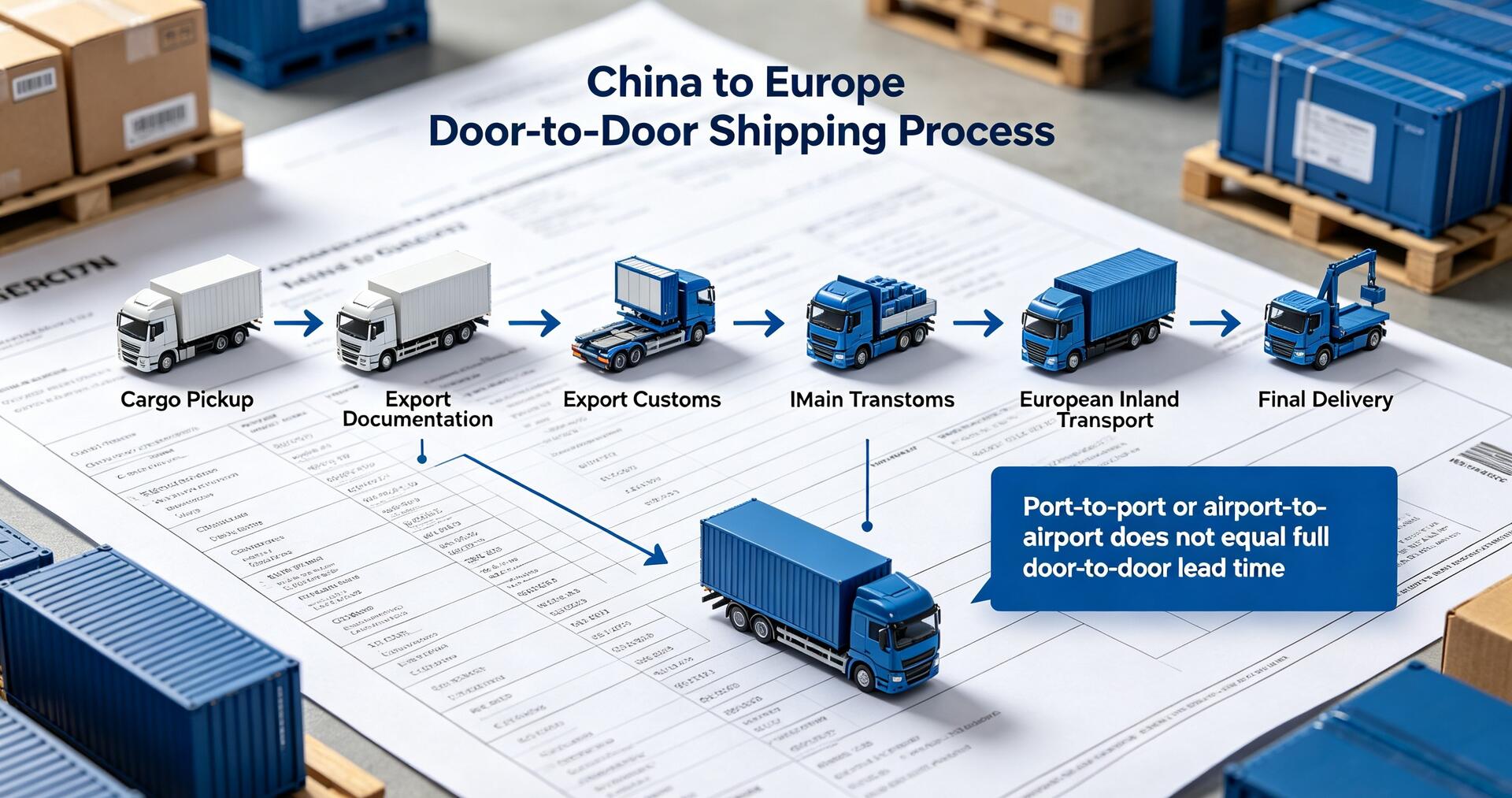
Shenzhen, Guangdong Sep 28, 2026 (Issuewire.com) - A useful estimate of shipping time from China to Europe (https://www.transworldcn.com/europe/) starts with the exact shipment, not a continent-wide average. Origin, destination, transport mode, customs procedures and final delivery all affect the date when goods become available to the buyer. TransWorld (https://www.transworldcn.com/About-us/) presents a planning framework that separates the main international journey from the full logistics process. Express generally prioritizes speed, air freight serves time-sensitive commercial cargo, ocean freight accommodates larger loads, and rail or multimodal services can suit particular routes. None provides one delivery time that applies to every European destination. What Determines the Total Lead Time? A shipment may pass through eight stages: supplier preparation and pickup; export documentation; inland transport to a Chinese airport, rail terminal or seaport; export customs clearance; international transportation; import customs processing; European inland transport; and final delivery. A carrier's flight or sailing estimate may cover only the international segment. Production, warehouse handling, terminal procedures, clearance and final-mile delivery can sit outside that figure. A Shenzhen-to-Rotterdam shipment may therefore have a different overall timeline from a Guangzhou-to-Madrid shipment even when their transport modes are similar. The source guide also emphasizes the customs declaration as part of the formal EU import process. Logistics planning should cover the whole sequence rather than treating voyage duration as the delivery deadline. Compare the Transport Options The original transport-method comparison can be expressed as four choices: Express: Usually the fastest category, suitable for samples, urgent parcels and small shipments, but with a higher transport cost. Air freight: A fast option for commercial cargo requiring shorter lead times, normally costing more than sea freight. Ocean freight: Generally the slowest major option, suited to heavy or high-volume cargo, with longer and more variable transit. Rail or multimodal: A possible middle option for selected commercial flows, subject to the route and service being available. These are planning categories, not delivery guarantees. Check the selected carrier's schedule and the scope of the quotation before comparing estimated dates. Express: When Speed Comes First Express can suit product samples, replacement parts, urgent customer orders, small time-sensitive consignments, product testing and rapid e-commerce replenishment. It is not automatically the economical choice for a larger commercial load. The guide cites FedEx International Priority and International Priority Express as examples with advertised transit times of approximately 1-2 business days for selected services and destinations. This is not a universal China-to-Europe commitment. Pickup arrangements, cut-off times, customs, weekends, holidays, restricted commodities and destination conditions can affect the result. Air Freight: Commercial Cargo with a Shorter Deadline Air freight reduces the main international transport time compared with sea freight, but the complete delivery still includes pickup, export handling, airport processing, flight availability, import clearance, destination handling and inland transport. The source guide cites a particular DHL Global Forwarding comparison reporting approximately 4-7 days by air from China to Türkiye in 2026. That example concerns a specific logistics flow; it should not be presented as the standard transit time for all European destinations. Air freight can be useful for high-value or lightweight products, seasonal inventory, short selling cycles, urgent replenishment and time-sensitive business orders. The choice should consider the cost of carrying inventory and the consequences of a stockout, not simply the difference between air and sea freight charges. Ocean Freight: Capacity with a Longer Planning Window Containers make ocean freight a practical option for substantial shipments. Its delivery window depends on the carrier's route, departure frequency, transshipment arrangements, equipment availability, congestion, weather, security conditions and onward transport. The guide discusses separate Northern European and Mediterranean carrier networks, including connections through Rotterdam, Hamburg and Bremerhaven. It also reports an August 2026 Maersk announcement concerning an AE19 return to Suez routing. That dated example illustrates why a historical transit estimate should not replace confirmation of the actual sailing. Rail and Multimodal: Assess the Specific Route Rail and multimodal services may offer an alternative where the origin, destination, cargo and available capacity support them. Multimodal transport combines modes such as truck, rail, air or ocean within one journey. The source guide uses DHL's TRUCKAIR road-and-air service as an example, reporting approximately 9-11 days from China to Türkiye compared with about 4-7 days for the air-only option. These figures illustrate one service comparison, not a promised timeline for Europe as a whole. Port-to-Port Is Not Door-to-Door Consider two hypothetical quotations: one offers 25 days port-to-port; another offers 28 days door-to-door. The first is not automatically faster for the importer. The port-to-port offer may exclude Chinese inland transport, export handling, destination customs, port processing, European trucking and final delivery. The second may include those stages. For inventory decisions, the date goods reach the receiving address is generally more relevant than the date a vessel reaches port. A comparable quotation should state the pickup location, loading port or airport, arrival gateway, final address, transit estimate, customs responsibilities, inland transport, shipping terms, and included or excluded charges. Use the same delivery scope when comparing providers. How Customs Affects the Schedule Clearance can take longer when officials need clarification of the goods, classification, customs value, origin or regulatory compliance. The guide cites the European Commission's explanation of customs declarations and identifies EORI information as important for EU customs operations. Depending on the shipment, preparation may include a commercial invoice, packing list, bill of lading or air waybill, import declaration, EORI details, origin documents, product certificates, licenses, permits and additional records for regulated goods. Requirements depend on the product and destination. Identify these requirements before the cargo leaves China. Four Ways to Reduce Avoidable Delays Confirm classification. Establish the appropriate HS classification using a precise product description rather than relying solely on a supplier's informal wording. The source guide identifies the European Commission's Access2Markets platform as a product-specific resource for tariffs, taxes and import requirements. Prepare consistent commercial documents. An invoice should clearly identify the seller, buyer, product, quantity, unit price, total value, currency, origin, shipping information and applicable Incoterms rule. A precise description is more useful than a generic reference to parts, accessories or samples. Check valuation. Do not intentionally reduce declared values to lower customs charges. The guide emphasizes applicable valuation procedures and warns that incorrect declarations can cause questions, delays, penalties and unexpected costs. Choose the mode for the business need. Consider value, weight, volume, urgency, inventory cost and the customer deadline together. Express may fit samples, air may fit urgent replenishment, sea may fit container-scale orders, and rail or multimodal may fit a suitable commercial lane. A Practical Planning Checklist 1. Define the cargo. Record the product, quantity, weight, dimensions, carton count, total CBM, value and HS code. 2. Identify the complete route. Specify the pickup and receiving locations. Shenzhen to Rotterdam and then a German warehouse is more useful than a general China-to-Europe description. 3. Compare available modes. Assess express, air, ocean, rail and multimodal against the shipment's requirements rather than ranking them only by speed. 4. Confirm customs needs. Check classification, EORI information, import requirements, certificates, valuation and any product restrictions. 5. Request the full price. Include freight, origin and destination charges, clearance, duties, taxes, delivery, insurance and applicable fuel or security surcharges. 6. Define the quoted time. Establish whether it covers port-to-port, airport-to-airport or complete door-to-door movement. A Hypothetical Warehouse Replenishment Example An importer buying finished products from South China for a European distribution warehouse needs more than a generic transit estimate. The useful information includes the supplier's location, product, volume, weight, receiving warehouse, required date, customs details and preferred mode. With that information, the alternatives become clearer. Express can serve urgent samples or small loads. Air can suit a larger commercial replenishment that must arrive quickly. Ocean can support substantial quantities when inventory is planned further ahead. A multimodal arrangement may balance cost and time on an available route. This is a hypothetical planning example, not a documented customer result. Its lesson is that detailed route and cargo information produces a more meaningful estimate than a universal number of days. Keep the Plan Flexible Transport networks change. Vessel rotations, port calls, routes, capacity and surcharges can all shift, so a workable plan should remain tied to the chosen service and shipment conditions. The best method is the one that meets the required service level at an acceptable total logistics cost. For information about European routes and shipment planning, visit the TransWorld official website (https://www.transworldcn.com/).
Media Contact
TRANSWORLD *****@transworldcn.com http://www.transworldcn.com/