Dongguan, Guangdong Jul 10, 2026 (Issuewire.com) - Automotive seating production operates under engineering constraints that most manufacturing sectors never encounter. Fatigue cycles run into the millions. Temperature exposure spans extreme ranges. Dimensional tolerances leave almost no room for batch-to-batch variation. For production engineers and equipment sourcing teams navigating these demands, identifying a China Top Spring Coiling Machine For Automotive Seating System Manufacturer requires more than reviewing a specification sheet. It demands a structured understanding of how machine architecture, material handling capability, and system integration translate into real production outcomes. This guide walks through the key evaluation checkpoints — from spring geometry requirements to supplier qualification criteria.
Understanding Automotive Seating Spring Specifications Before Selecting Equipment
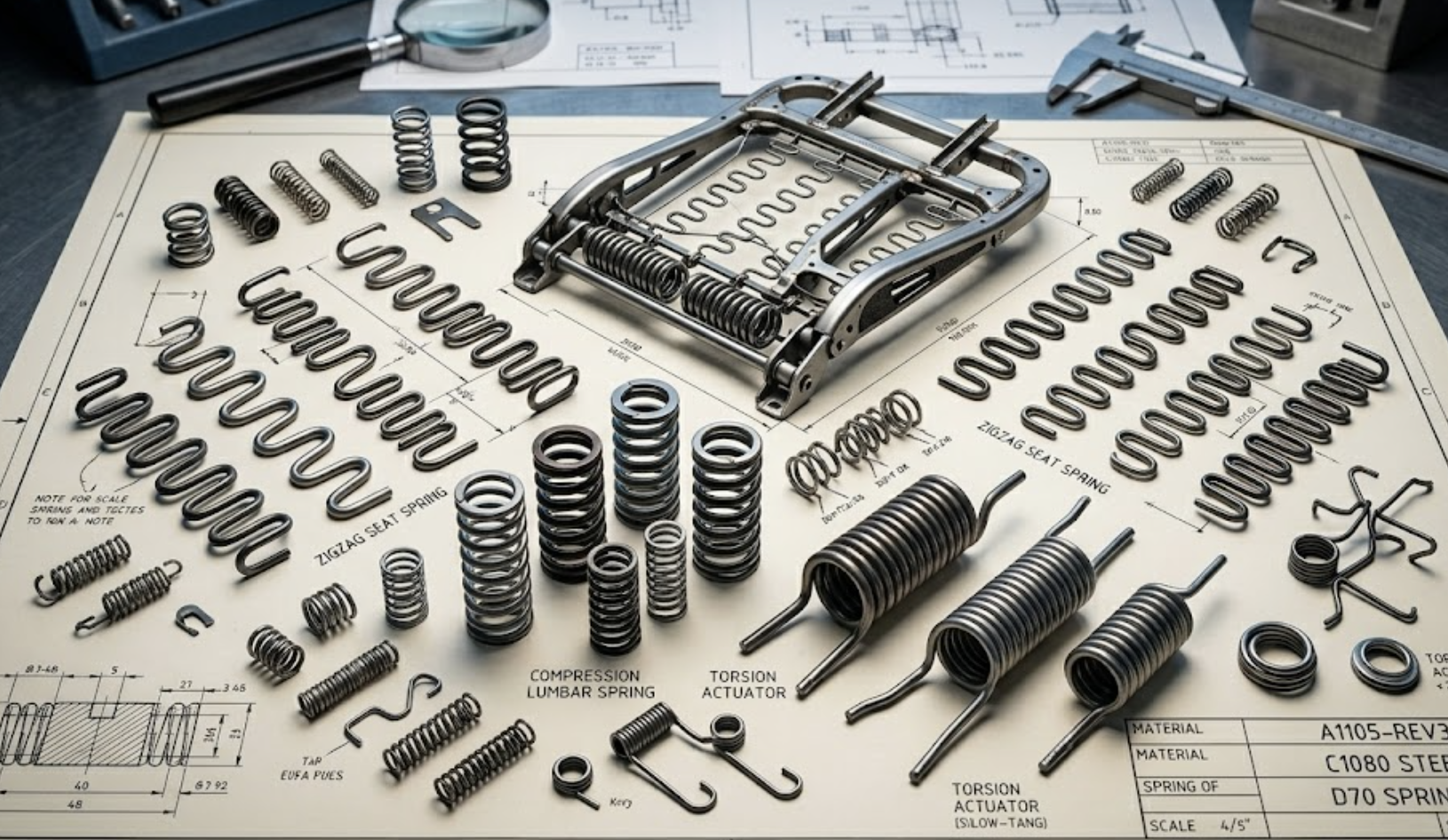
Equipment selection that starts with machine catalogs tends to produce mismatches. The more reliable starting point is the spring itself. Automotive seat cushion compression springs must sustain millions of load cycles without permanent set. Backrest torsion springs and adjustment mechanism components operate across temperature ranges from roughly -40 degrees Celsius to +80 degrees Celsius, maintaining consistent force characteristics throughout. Serpentine springs — also called zigzag or snake springs — require uniform pitch and consistent cross-sectional geometry to deliver even load distribution across the seat base.
These performance requirements translate directly into machine demands: precise wire feeding control, stable forming force under high-speed cycles, and consistent axis coordination across the full production run. Getting clarity on spring type, wire diameter, and acceptable dimensional variance before shortlisting equipment narrows the field considerably and prevents costly restarts after installation.
Axis Count and Forming Complexity: How to Match Machine Architecture to Spring Geometry
Axis count is not a quality signal on its own. It is a forming capability signal. A 2-axis high-speed coiling machine suits high-volume standard compression spring production efficiently. It handles repetitive geometry at speed, making it the right tool for seat cushion base springs produced in large batch volumes with consistent specifications.
A 6-axis CNC coiling machine addresses a different problem. SMS — full company name EASTON PRECISION TECHNOLOGY (DONGGUAN) CO., LTD. — produces its SMS-CNC-660 and SMS-CNC-680 models with six independently controlled servo axes. The X-axis manages wire feeding with a precision of plus or minus 0.01mm. The Y-axis controls coil diameter in real time. The Z-axis handles dynamic pitch adjustment. Three auxiliary axes cover end closing, cutting, and multi-angle bending operations. Together, this architecture produces conical springs, double-taper springs, variable-pitch springs, and hook-end geometries within a single forming cycle. No secondary operations are necessary. For automotive seating applications involving lumbar support mechanisms, headrest adjustment components, or reclining system springs, this capability gap between 2-axis and 6-axis machines directly affects part quality and production efficiency.
Wire Diameter Range and Material Compatibility — A Practical Specification Checklist
Wire diameter selection is closely tied to both spring function and equipment specification. Seat cushion base springs typically require heavier wire to carry passenger load. Backrest and lumbar adjustment springs often use lighter, more flexible wire to achieve the precise force gradients ergonomic designs demand. Headrest springs occupy yet another specification band.
The SMS-CNC-660 processes wire diameters from 2.5mm to 6.0mm, with a maximum outer coil diameter of 110mm. The SMS-CNC-680 handles 3.0mm to 8.0mm wire and extends to 120mm outer diameter. Both models process carbon steel, stainless steel, music wire, phosphor bronze, and titanium alloy. This material range matters because automotive seating components increasingly incorporate specialty wire grades for weight reduction and corrosion performance. A machine that handles only standard carbon steel becomes a bottleneck when product specifications evolve. Verifying material compatibility across the full anticipated range — not just the current product — is a practical step that protects the equipment investment over time.
Production Speed vs. Dimensional Consistency — Setting Realistic Output Benchmarks
Speed figures in equipment brochures rarely tell the full story. The 6-axis SMS coiling machine reaches production rates of 120 to 180 pieces per minute. However, that range reflects variation based on spring complexity. Simpler geometries approach the upper end. Springs with variable pitch, tapered diameters, or closed and ground ends operate toward the lower end of that range.
For automotive seating manufacturers, consistency across the production run matters more than peak speed. A spring that measures within tolerance on piece one but drifts by piece five hundred fails automotive supplier quality requirements regardless of its theoretical output rate. The heavy-duty cast iron frame construction in EASTON PRECISION TECHNOLOGY (DONGGUAN) CO., LTD. machines minimizes vibration accumulation at high cycle rates. Combined with servo motor technology from established Japanese manufacturers, this structural approach sustains forming accuracy over extended production runs — not just during initial setup verification.
Beyond the Coiling Head — Evaluating Peripheral System Integration
Selecting a coiling machine in isolation from its surrounding production environment leads to integration problems that surface during line commissioning. Automotive seating springs frequently require heat treatment after forming to relieve internal stress and stabilize spring rate. In-line tempering furnaces positioned immediately after the coiling head allow continuous processing without manual handling between operations.
SMS (EASTON PRECISION TECHNOLOGY (DONGGUAN) CO., LTD.) manufactures and supplies in-line tempering furnaces and spring end grinding machines alongside its coiling equipment range. This matters practically. When the coiling machine, furnace, and grinding equipment originate from the same manufacturer, parameter compatibility and mechanical integration are engineered rather than improvised. Auto wire feeders and finished-part collection systems extend the automation scope further. For Tier 1 automotive suppliers running high-volume lines, the difference between a coordinated production cell and a collection of independently sourced machines reflects directly in commissioning time, line efficiency, and ongoing maintenance accountability.
Smart Manufacturing Readiness: What Industry 4.0 Integration Actually Requires
Automotive manufacturers increasingly require production data traceability from component suppliers. This expectation extends to the spring manufacturing equipment feeding their seating assembly lines. Real-time production monitoring, fault detection with automatic stop functions, and remote diagnostics are no longer advanced features — they are baseline requirements for suppliers entering or maintaining Tier 1 relationships.
The SMS 6-axis coiling machine operates with a multilingual touchscreen HMI that supports English and Chinese as standard, with additional language options available. A graphical programming interface stores spring parameter libraries and enables one-click program recall between production runs. The system logs production data and supports compatibility with MES and ERP platforms, enabling full traceability. For equipment investment decisions, the distinction between a machine that simply produces springs and one that participates in a connected manufacturing environment represents a meaningful difference in long-term operational value.
Supplier Qualification Standards: A Technical Checklist for Automotive Seating Manufacturers
Engineering capability on paper requires operational verification before a supply relationship can be trusted. Six criteria warrant direct assessment when evaluating a spring coiling equipment manufacturer.
First, servo system provenance — whether the motion control components originate from verifiable manufacturers with documented performance records. Second, in-house tooling capability — whether the manufacturer produces its own wire-sized tooling or relies on external sources, since tooling consistency affects forming repeatability directly. Third, post-delivery support scope — whether on-site installation, operator training, and technical support are included or treated as optional extras. Fourth, spare parts response time — critical for minimizing unplanned downtime in high-volume seating production environments. Fifth, manufacturing geographic distribution — SMS operates three factory locations across Dongguan in Guangdong, Jinghai in Tianjin, and Wujing in Changzhou, providing production redundancy and logistics flexibility for both domestic and export customers. Sixth, global service agent coverage — regional technical support through agents across Asia, Europe, and the Middle East reduces response lag for international buyers.
These six criteria, applied consistently, separate manufacturers who can supply equipment from those who can sustain a production partnership through the full equipment lifecycle.
Full product specifications, application case references, and manufacturing capability information are available at https://www.smswiressolution.com/.
Media Contact
EASTON PRECISION TECHNOLOGY (DONGGUAN) CO.,LTD *****@smsolution.cn Block 3 Unit 3 No 398 Kechuang Road, Nancheng Street, Dongguan China https://www.smswiressolution.com/