
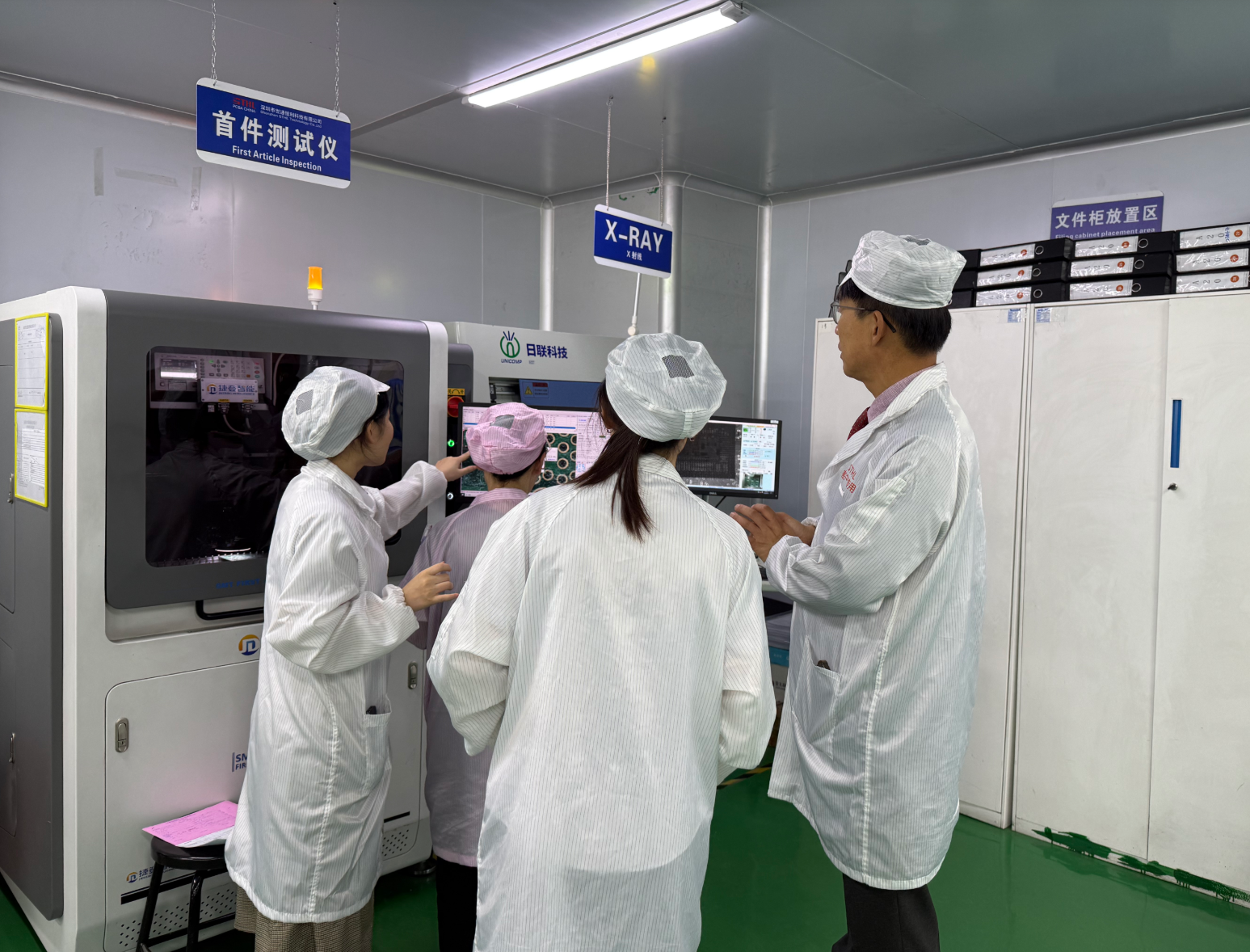
Shenzhen, Guangdong Sep 28, 2026 (Issuewire.com) - Last Friday, September 11th, a hardware team from a South Korean device manufacturer flew into Shenzhen for something most suppliers dread: an audit with no slides allowed. They didn't want a PowerPoint. They wanted to walk the floor, watch the line run, and see exactly what happens to their boards between "order confirmed" and "box shipped."
That visit is the reason we're writing this. Most buyers only ever see two data points from a PCBA supplier: a quote and a certificate wall. What actually determines whether a board works in the field — and keeps working after six months inside a customer's product — happens in between, on the floor, in steps most quotes never mention. Here's what we walked them through.
Before a single component is placed
Every job starts with a DFM (Design for Manufacturability) review, not a purchase order stamp. Our engineering team checks footprint tolerances, panelization, pad spacing, and component placement against what our SMT lines can actually run. This is the cheapest place to catch a problem. A footprint issue found here costs an email. The same issue found after the first production run costs a batch of scrap, a delayed shipment, and a hard conversation with your own customers. We'd rather have that conversation with you two days into a project than two weeks before your ship date.
Where the components actually come from
Sourcing is where a lot of quality problems quietly start at other suppliers — cheaper gray-market parts swapped in without telling the customer. We source through Mouser, Digi-Key, Farnell, Future, Avnet, and Arrow, alongside direct manufacturer and authorized agent relationships. No substitutions go out without customer sign-off, full stop. If a part is genuinely unavailable and a customer agrees to an alternative, our engineering team evaluates the swap for cost and performance before it's approved — not after it's already on the board. Every incoming batch, regardless of source, goes through IQC (Incoming Quality Control) before it's cleared for the line, checking for counterfeit risk, dimensional accuracy, and datasheet compliance.
Inside the build: SMT and DIP
STHL runs 7 high-speed SMT production lines and 2 DIP/THT assembly lines across a 10,000 sqm facility staffed by more than 200 people. On the SMT side, each line pairs automated solder paste printing with SPI (Solder Paste Inspection), which checks paste volume and alignment before a board ever reaches the reflow oven — because most solder defects trace back to paste problems, not placement problems. After reflow, AOI (Automated Optical Inspection) checks every board for placement accuracy, tombstoning, and bridging before it moves further down the line.
For through-hole components — connectors, heat sinks, DC fans, and mechanical hardware that SMT can't handle — our 2 DIP/THT lines run wave soldering up to 300°C, with fixtures used to protect sensitive components during the process. Our ERP and MES systems track every board through this entire sequence by batch, which is how we can quote a 99% first-pass yield and actually pull up the number for any given production run instead of just citing it as a marketing line.
Proving it works, not just that it looks right
This is usually the part clients find most reassuring, because it's the part that catches what a visual inspection alone would miss. Beyond AOI, boards go through X-ray inspection to check hidden solder joints under BGA and QFN packages — connections you'd otherwise never see until the board fails in the field. From there, boards move to ICT (In-Circuit Test) using flying-probe testing, followed by full functional testing on our dual FCT (Functional Circuit Test) lines. Final inspection includes OQC (Outgoing Quality Control) and 3D microscope verification before anything gets cleared for packing.
For customers running box-build or finished-device programs, we also operate 2 dedicated box-build assembly lines for labeling, Housing Assembly, and final packing — so the board that leaves QC isn't the last step before it reaches your warehouse.
Why a certificate wall isn't the whole story
We do hold IATF16949 (automotive), ISO9001 (quality management), ISO13485 (medical devices), and ISO14001 (environmental) — and they matter, because they force a documented, auditable process across the whole factory rather than a one-off effort for a big customer. But a certification describes a system that's supposed to be in place. A site visit is where a client actually checks whether it is. Our Korean visitors didn't ask to see the certificates on the wall — they asked to see the SPI reject rate on the line running that day, and to watch a board go through ICT in real time.
What we'd suggest asking on your own visit
If you're evaluating a PCBA partner and a spec sheet isn't giving you enough to decide, here's what tends to actually reveal how a factory runs day to day: ask to see the DFM report for a recent project, not just the final board. Ask what happens to a batch that fails AOI — is there a documented rework process, or does it just get quietly reworked off the books? Ask to see MES data for a specific batch number, not a summary dashboard. And ask where your production schedule sits relative to other jobs on the line right now — a supplier that can answer that in real time is one that actually knows what's happening on their own floor.
Our Korean visitors left with photos of the SMT line mid-run, a copy of their DFM review notes, and a production schedule showing exactly where their first batch sits in the queue. Not a brochure.
If your team is weighing a PCBA partner and would rather see the floor than read another deck, we host client visits and virtual factory walkthroughs regularly — reach out and we'll set one up.
Media Contact
Shenzhen STHL Electronics Co., Ltd. *****@sthlpcba.com https://www.sthlpcba.com/