
Shenzhen, Guangdong Jun 25, 2026 (Issuewire.com) - The Paradigm Shift in AMR Infrastructures: Why Operational Lifespan Dictates Utility ROI
Utility operators around the world are rethinking how they manage metering infrastructure. Manual meter reading is giving way to Automatic Meter Reading (AMR) and Advanced Metering Infrastructure (AMI) systems at a pace that would have seemed ambitious just a decade ago. These deployments span millions of endpoints, and what keeps them running quietly in the background is something most end-users never think about: the battery inside each device. For procurement teams, that detail is anything but trivial. Working with a proven Wholesale ER26500 Smart Meter Battery Factory has become a baseline requirement for utilities that want to protect their infrastructure investments over the long haul.
The communication side of modern metering has changed considerably too. LPWAN protocols — NB-IoT, LoRaWAN, Sigfox — now carry meter data across long distances without physical network lines, which sounds straightforward until you look at what those transmission patterns actually do to a battery. These devices spend most of their lives in deep sleep, then briefly wake to fire off a burst of data. That irregular pulse behavior puts real stress on a cell in ways that traditional low-drain applications never did.
The financial math here is fairly unforgiving. Replacing batteries in underground water meters or wall-mounted gas meters scattered across a service territory is expensive — in many cases, the labor cost alone exceeds the original value of the meter. That's why field asset managers tend to work backwards from a minimum deployment lifespan of ten to fifteen years when they're evaluating power sources. A battery that falls short of that mark doesn't just create a maintenance headache; it quietly erodes the return on an entire infrastructure program. Fewer truck rolls mean lower costs and a more stable grid. It really does come down to that.
Electrochemical Mastery: Why the C-Size ER26500 Li-SOCl2 Chemistry Rules Smart Gas & Water Meters
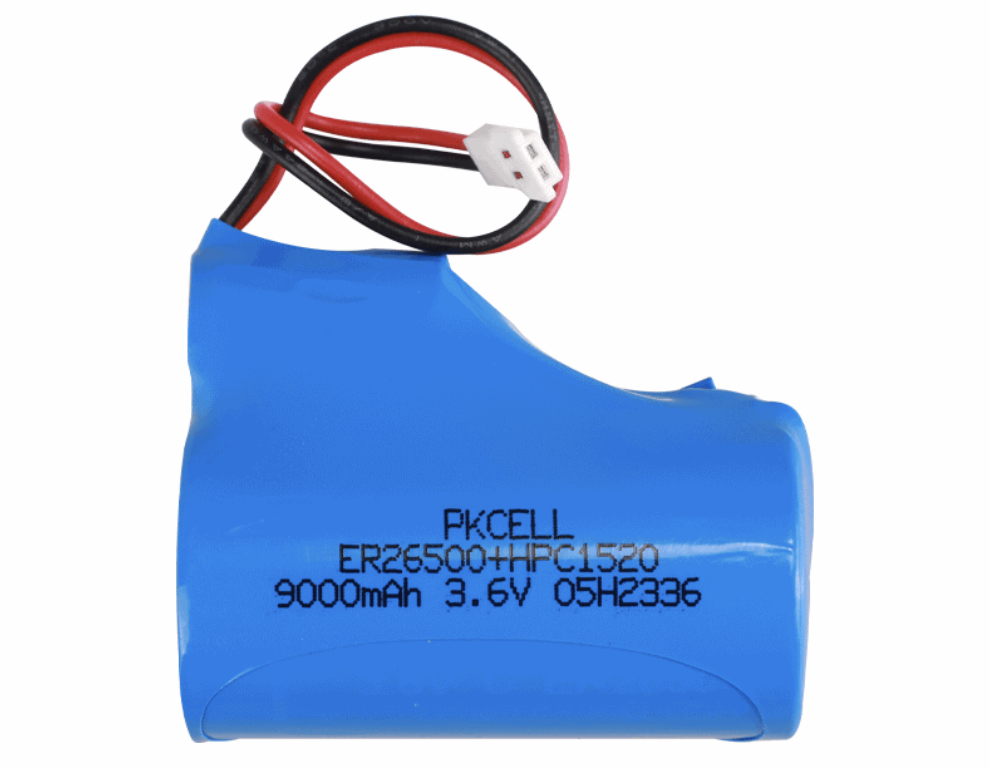
Not every battery chemistry handles this kind of deployment well. Lithium Thionyl Chloride — Li-SOCl2 — has earned its dominant position in smart metering for reasons that become clear when you look at the operating conditions involved. The C-size ER26500 cell sits at a useful middle ground: compact enough to fit standard meter housings, but with enough capacity to sustain a decade of periodic transmissions.
The 3.6V nominal voltage holds remarkably flat throughout the discharge cycle. There's no gradual slope downward as the cell depletes — it maintains useful voltage right up until capacity is nearly gone. A lot of that stability comes down to passivation, a natural electrochemical process where a thin lithium chloride film forms over the anode during idle periods. That film acts as a kind of internal seal, slowing self-discharge to under 1% per year in well-engineered cells.
The catch with passivation is that it can cause a brief voltage dip when the meter wakes up and demands power after a long rest period. The C-size form factor helps address this directly — the cell's surface area is large enough to break down the passivation layer almost instantly when a transmission begins, keeping the voltage response fast enough to avoid dropped data packets. This is a meaningful design consideration for any smart water meter power solution where communication reliability is non-negotiable. The Bobbin-type internal structure also maximizes the volume of active electrode material within the cell, which translates to higher total energy output over the deployment period.
Inside the PKCELL Smart Factory: Engineering Reliability from Material to Complete Cell
Raw electrochemistry only delivers on its promises when the manufacturing behind it is consistent. In large utility deployments, a batch of cells with slightly inconsistent internal resistance can cause localized network gaps years into a contract — the kind of problem that's expensive to diagnose and even more expensive to fix. This is where factory quality becomes an infrastructure question, not just a procurement preference.
PKCell (Shenzhen Pkcell Battery Co., Ltd.) operates on the premise that meaningful quality control has to be built into every stage of fabrication, not applied at the end. Automated assembly handles the winding and electrolyte-filling stages — the steps most sensitive to human variability — which keeps internal resistance and physical tolerances consistent across production batches.
Environmental testing is taken seriously here too. Smart meters live in some genuinely harsh places: submerged valve pits that sit below freezing for months, outdoor enclosures that bake in summer heat. PKCell puts finished cells through thermal chambers that cycle from -55°C to +85°C, and engineers evaluate electrolyte behavior throughout that range rather than just checking end-state performance. Safety in gas-meter applications adds another layer of requirements. The ER26500 cells use hermetic glass-to-metal sealing to contain the electrolyte over time, combined with structural pressure vents that activate if internal gas buildup ever approaches unsafe levels. Every finished cell passes automated inspection before it ships.
The B2B Procurement Blueprint: Selecting and Customizing ER26500 Solutions for Global Scale
Utility deployments vary considerably in their power demands, and battery configurations need to reflect that. The two most common formats for AMR applications are the 3.6V ER26500 1S2P pack at 17,000mAh — a reasonable fit for standard metering nodes with moderate transmission frequency — and the 3.6V ER26500 1S4P pack, which pushes capacity to 36,000mAh for installations that need more headroom.
The 1S4P configuration is particularly relevant for multi-protocol communication hubs, remote data loggers, and automated gas valves, where peak current demands are higher and data synchronization happens more frequently. Treating these as off-the-shelf components only goes so far. PKCell's engineering team works with buyers on OEM and ODM configurations — adjusting wire harness lengths, selecting connectors for specific housings, and integrating protective circuit boards with diodes and PTC devices for short-circuit and reverse-current protection.
Regulatory compliance is handled at the manufacturing stage rather than left to buyers to sort out. Cells are tested against UL, CE, UN38.3, and RoHS standards, which simplifies import processes and removes a layer of risk for utilities operating in regulated markets. For procurement teams managing large-scale rollouts, that kind of factory-level certification support is worth factoring into the supplier evaluation. A battery choice made carefully at the procurement stage tends to stay invisible for a decade — which, in infrastructure terms, is exactly what you want.
Corporate Website: https://www.pkcellpower.com/.
Media Contact
Shenzhen Pkcell Battery Co., Ltd. *****@pkcellpower.com 902, Tower B, Hongrongyuan North Station Center, North Station Community, Minzhi Street, Longhua District, Shenzhen, China https://www.pkcellpower.com/




